
Hinduism – Its Scriptures, Core Beliefs & Rituals
Published on: 18-Apr-2026The term Hindu is derived from the Indo-Aryan word Sindhu, which is translated as ‘river’. In Persian, this term became ‘Hindu’, and this was used as a designation of the river which is nowadays known as Indus which flows through the north-west of the subcontinent, i.e. present-day Pakistan. Later, the term came to be used to indicate the land through which the Indus river flowed and the people who lived in that area. In other words, the term ‘Hindu’ was simply a name which was coined by outsiders to designate a territory and it’s population. Otherwise it has no cultural or religious significance.
In the eighth century (CE), Muslims began to make their presence felt in the subcontinent, and some of the indigenous population converted to Islam. Consequently, the term Hindu came to indicate the people in the region who were not Muslims. During that era, the term Hindu was not applied to designate either a self-designated identity or a unified religious community. Later on, the term Hindu began to acquire a more narrow definition signifying Indians who were not Muslims, Christians, Sikhs, Parsis or Buddhists. Eventually, in the nineteenth century, the term Hindu acquired the suffix ‘ism’, and it came to be considered as being a single unified religious tradition. 1
Hinduism is called the oldest religion in the world, 2 and some practitioners and scholars refer to it as Sanatana Dharma,3 "The eternal law," or the "Eternal Way". Scholars regard Hinduism as a fusion or synthesis 4 of various Indian cultures and traditions,5 with different roots and no founder. 6 This "Hindu Synthesis" started to develop between 500 BCE and 300 CE following the Vedic period (1500 BCE to 500 BCE). 7
Modern Hinduism
The current terms, 'Hinduism' and 'Brahmanism,' are of European origin. Only Hindu is the general term for 'religion' being Dharma, denned as 'established order, usage, institution, custom, prescription; rule, duty; virtue, moral merit, good works; right, justice, law'. According to Manu (Laws, II. 6
Thither is a substantial conflict between the Hindu conception of the "Dharma" and the European understanding of "religion". To a European, Christianity or Christian religion are self-defined terms, and the acceptance of those ideas and practices that are indicated by the word would make a man Christian. In the case of Hindu-"Dharma," the relation is different. Hindus are a particular body, and Hindu-"Dharma" is that indefinite thing in which the Hindus believe in. The word Hindu is itself a foreign one. Hindus never used it in any Sanskrit writing, that is, those which were written before the Muslim invasion. In fact, there was no need of calling themselves by any particular name
One problem with the definition of Hinduism is the fact that it does not have a founder. It is an amalgamation of various ethnicities also known as the "Brahmanical orthopraxy, the renouncer traditions and popular or local traditions." 10
Division of Time
Regardless of philosophical differences, Hindus throughout the ages accepted certain divisions of empirical time, which were used both in daily life and in astronomical/astrological calculations. Different systems were and are used, but these disparities are not related to different ideological conceptions of time. The major divisions of time are affected by the revolutions of the moon, sun and Jupiter (Brhaspati). The lunar month is divided into a dark half (KRSNAPAKSA) and a bright half (SUKLAPAKSA); each half is divided into fifteen tithis (each with a specific name). The solar movement divides the year into six seasons (determined by entry of the sun into certain constellations) and twelve solar months. The seasons are vasanta (spring), grisma (hot season), varsa (rainy season), sarad (autumn), Hemanta (winter), sisira (cool season). The months (beginning with Caitra in spring) are neither identical with the months of the Western calendar nor with the lunar months. Now and then an intercalary month is needed to realign the beginning of springtime with the commencement of the month Caitra (or Mesa). Different schools of astronomers issue yearly calendars/almanacs (pancanga) which are adopted by various groups of people. Major feasts are sometimes noted on different days (even a month apart) because of the discrepancies between the calendars. For astronomical/astrological calculations the nakshatras (‘houses’) are important. Overall, there are 28 nakshatras, each measuring 13o20’ of the ecliptic. Each Nakshatra is then subdivided into four padas of 3020’ each. Above the lunar and solar cycles, the 12- year and 60-year cycles of Jupiter are important.
The 24-hour solar day is subdivided into 30 muhurtas (48 minutes each) and each muhurta is subdivided into two ghati (of 24 minutes each). Each ghati is subdivided into 30 kala (of 48 seconds each) which is split into 2 pala (of 24 seconds each). Then each pala is divided into 6 pranas (of 4 seconds each) which is further divided into 10 vipala (of 0.4 seconds each) and each vipala into 60 prat vi pala (0.000666 seconds each). One month in human terms is considered to be one day and night of the pitr (deceased ancestors); one human year is equal to one day and night of the deva (gods); one thousand years of the Deva is equal to one day of Brahma. History is reckoned in man van Tara, ‘ages of patriarchs’ of which there are fourteen; each presided over by a specific Manu. The largest time-frame are the kalpas (aeons) equal to 4,320,000 years and subdivided into 4 Yogas, each successively shorter and more wicked than the preceding one.
Concept of Yogas
Yoga in Hinduism is a period or era within a four-age cycle. A complete Yoga starts with the Satya Yoga, via Treta Yoga and Dvapara Yoga into a Kali Yoga. Our present time is a Kali Yoga, which began in 3102 BCE with the end of the Mahabharata war. 11 Attempts have been made to assign a historical date to the Kurukshetra War. Popular tradition holds that the war marks the transition to KaliYoga and thus dates it to 3102 BCE.]
There are four Yogas in one cycle:
- Satya Yoga. (17,28,000 years)
- Treta Yoga. (12, 96,000 years)
- Dwapara Yoga. (8,64,000 years)
- Kali Yoga. (4,32,000 years)
Characteristics of each Yoga
Satya Yoga (Also known as Krita Yoga "Golden Age")
It was the first and best Yoga since it was the age of truth and perfection. The Krita Yoga was so prominent because only one religion existed, and all men were saintly. Consequently, they were not commanded to perform any religious ceremonies. The caste system was very flexible. Humans were gigantic, powerfully built, handsome, honest, youthful, vigorous, erudite and virtuous. The Vedas were one. All humanity could attain to supreme blessedness. There was no agriculture or mining as the earth yielded those riches on its own. The weather was pleasant, and everyone was glad. There were no religious sects. There was no disease, decrepitude or fear of anything. Human lifespan was 100,000 years, and people tended to have hundreds or thousands of sons or daughters. People had to perform penances for thousands of years to acquire Samadhi and die.
Treta Yoga
It is considered to be the second Yoga in order which means the "Third". In this age, virtue diminishes slightly. At the beginning of the age, many emperors rise to dominance and conquer the world. Wars become frequent, and the weather begins to change to extremities. Oceans and deserts are formed. People become slightly diminished compared to their predecessors. Agriculture, labour and mining become existent. The average lifespan of humans lessens to around 1000-10,000 years.
Dvapara Yoga
It is considered to be the third Yoga in order. Dvapara means "two pairs" or "after two". In this age, people become tainted with Tamasic qualities and are not as strong as their ancestors. Diseases become rampant. Humans are discontent and fight each other. Vedas are divided into four parts. People still possess characteristics of youth in old years. The average lifespan of people further lessens to around a few centuries.
Kali Yoga
The last age. It is the age of darkness and ignorance. People become sinners and lack virtue. They become slaves to their passions and are barely as powerful as their earliest ancestors in the Satya Yoga. Society falls into disuse, and people become liars and hypocrites. Knowledge is lost, and scriptures are diminished. Humans eat forbidden and dirty food and engage in unrestrained sinful sexual practices. The environment is polluted, water and food become scarce. Wealth is heavily diminished. Families become nonexistent. The average lifespan of people is barely 100 years, though, by the end of the Yoga, it will be as low as 20 years.
The ages see a gradual decay of Dharma, wisdom, knowledge, intellectual capability, life span, emotional and physical durability.
Satya Yoga
Virtue reigns supreme. Human stature was 21 cubits. 12Average human life span was 100,000 years.
Treta Yoga
There was three-quarter virtue & 1 quarter sin. Average human stature was 14 cubits and the average human lifespan was 10,000 years.
Dwapara Yoga
There were one half virtue & 1 half sin. Average human stature was seven cubits. Average human life span was 1,000 years.
Kali Yoga
There is one quarter virtue & 3 quarter sin. Average human stature is 3.5 cubits. The average human life span will be 100 years. 13
Sacred scriptures of Hinduism
There are thousands of different Hindu texts, of diverse types. These scripts are separated into two classes:
- Those that have primary authority are referred to as ‘that which is heard’ (Shruti);
- Secondary texts are referred to as ‘that which is remembered’ (smrti).
There is no universal or absolute agreement on which books fall into which category. Nevertheless, it concurs that the Vedas belong to the main category of Shruti. Of the Shrutis (Vedic corpus), the Upanishads alone are widely influential among Hindus. They are considered scriptures par excellence of Hinduism and their central ideas have extended to influence its thoughts and traditions. 14
The Smriti texts are a specific body of Hindu texts attributed to an author, as a derivative work they are considered less authoritative than Shruti in Hinduism. 15 The Smrti literature is a vast corpus of various texts. It includes, but is not limited to Vedangas, the Hindu epics, the Sutras and Shastras, the texts of Hindu philosophies, the Puranas, the Kavya or poetical literature, the Bhasyas, and many Nibandhas (digests) covering politics, moral philosophy, culture, arts and social club. 16
Many ancient and medieval Hindu texts were written in Sanskrit and others in regional Indian languages. In modern times, most ancient texts have been translated into other Indian languages and some in Western languages. Before the beginning of the common era, the Hindu texts were composed orally. They were memorised and transmitted orally, from one generation to the next, for more than a millennia before they were written down into manuscripts. This oral tradition of maintaining and transmitting Hindu texts, from one generation to the next, continued into the mod epoch. 17
The details of some famous sacred books of Hinduism are givrn below:
The Vedas
The Vedas are regarded as providential. They are considered to contain an eternal truth which was revealed to the Vedic seers. The structure of the Vedas is highly complex. There are four different Vedas and four different strata to each of these Vedas. The earliest portions of the Vedas are the Samhitas of the Rigveda. These, for the most part, are extravagant hymns of praise to the various devas. The Samhitas of the Rigveda only record the hymns and give no indication as to how they were sung or incorporated into ritual practice. The majority of the Samaveda comprises hymns taken from the Rigveda and arranged in a form for use in a ritual context with notations as to how they were to be chanted in the ritual. The Yajurveda also derives a lot of its substance from the Rigveda Samhitas. It likewise holds a collection of prose formulae, known as ya jus, which was muttered by a priest during the ritual. The manner and substance of the Atharvaveda are entirely dissimilar to that of the other three Vedas, as it is a lot less concerned with the ritual and mostly contains spells and magical spells to ward off problems of daily living, such as ill health, snake bite and other things.
There is a rough chronological development through the strata or genres of the Vedic corpus. Nevertheless, it is significant to mention that the boundary between these different genres is not always distinct. The Samhitas are verse compositions and are the earliest portion of the Vedas. They are primarily focused on the devas. The Samhitas also contain the mantras, which Fritz Staal identifies as ‘bits and pieces from the Vedas put to ritual use’. These mantras are still incorporated in various Hindu rituals, even though many people may no longer understand their meaning. The Brahmanas are following prose compositions and may be considered as appendices to the Samhitas. The Brahmanas primarily focus on the correct performance of the ritual itself. Identifiable in the Brahmanas is the concept that creation is governed by an original order and is not merely the subject of the capricious intervention of greater powers. This idea of an intrinsic order is referred to as the Dharma, which gets a common topic in much Hindu thought. The Aranyakas develop some of the thoughts in the Brahmanas. Aranyaka roughly translates as ‘forest or wilderness treatise’, which suggests that this portion of the Vedas contained esoteric knowledge.
The term Upanishad more or less translates as ‘to sit near’. This shows a group of students sitting near to a teacher (guru) and seems to entail that the teachings were regarded as esoteric. The focal point of the Upanishads is the significance of ritual performance. There are 108 canonical Upanishads, and 14 of these are considered particularly significant. As with all Hindu texts, it is tough to date the Upanishads accurately. The earliest were probably composed about the eighth century BCE, and the latest were probably written towards the beginning of the Common Era. Consequently, even when looking just at the Upanishads, it is not possible to identify a consistent doctrine. Nonetheless, it is clear that some new interrelated ideas emerged in this period, ideas that became central to most subsequent forms of Hinduism. These are: there is a continuous cycle of life, dying and rebirth (Samsara); that activity (karma) is the driving force of Samsara; and that it is possible to escape the cycle of transmigration (mokqa).
The Upanishads are sometimes referred to collectively as Vedanta, which means ‘the end of the Veda’. The implication is not just that the Upanishads appear as the last portion of the Vedic corpus, but also that they represent the culmination of the thought that has preceded them in the other strata of the Vedas. Vedanta is also the term used in philosophical schools of thought that base their metaphysical speculation on ideas found in the Upanishads. 18
The Puranas
Traditionally, there are said to be 18 Puranas. As with all genres of Hindu religious texts, there are no clear standards for deciding what defines the Puranas. Ludo Rocher suggests a list of 82. Some important themes can be identified in the Puranic literature, which continues to inform the Hindu worldview significantly. These themes constitute what Madeleine Biardeau (1994) has called ‘a universe of Bhakti’. This is a context in which devotion to a personalised form of the deity, who is also considered as an all-pervading reality, is considered as the religious practice par excellence. The gods of what might be called the classic pantheon come into prominence in this universe, and deities like Siva, Vishnu and the goddess come to take precedence over the earlier Vedic devas.
This mythic universe is informed by a very sophisticated understanding of time and space. Just as the individual self (Atman) undergoes a continuous cycle of life, death and rebirth, so too does the universe. The universe is considered as alternating between manifestation and dissolution. The metaphor that is often used is that creation is like a spider that alternates between spinning the web and then reabsorbing it back into its body. This period is envisaged as a day and night of Brahma. The daytime of Brahma is the point when the universe is manifested and lasts for 4,320,000,000 years. The night of Brahma is the period when the universe resolves back into its similar form and lasts a similar length of time.
As well as developing a highly elaborate conception of time, the Puranic Cosmos also have a very complex notion of space. The Puranas suggest that there are many thousands of parallel universes. Furthermore, the Puranas propose that there are different worlds or realms (loka) inhabited by various beings. In particular, the Puranas suggest three worlds: the world of the gods (devas), the world of humans, and the world of demons (asuras). Although these are regarded hierarchically, it would be wrong to think of the realm of the asuras as equivalent to the Western concept of hell. In some places in the Puranas, seven or even fourteen different lokas are indicated. 19 These Hindu texts have been influential in the Hindu culture, inspiring major national and regional annual festivals of Hinduism. The Bhagavata Purana has been among the most celebrated and famous text in the Puranic genre. 20
Dharmasastra
It is a genre of Sanskrit texts and refers to the treatises (Shastras) of Hinduism on Dharma. There are many Dharmashastras, variously estimated to be 18 to about 100, with different and conflicting points of view as Robert Lingat mentions:
“Over 100 different Dharmasastra texts were known by the Middle Ages in India, but most of these are lost to history, and their existence is inferred from quotes and citations in bhasya and digests that have survived.”21
Each of these texts exists in many different versions, and each is rooted in Dharmasutras texts dated to first millennium BCE that emerged from Kalpa (Vedanga) studies in the Vedic era. 22
The textual corpus of Dharmasastra was composed in poetic verses, is the part of the Hindu Smritis, constituting different commentaries and treatises on the obligations, responsibilities and ethics to oneself, to families and as a member of the social club. The texts include discussion of Ashrama (stages of spirit), Varna (social classes), purushartha (proper goals of life), personal virtues and responsibilities such as Ahimsa (non-violence) against all living beings, the rules of just war, and other issues. 23
Mahabharata
It is in the Epic literature, represented by the Mahabharata and the Ramayana, the literary evolution of the Neo-Brahmanism is elaborated. This period may be fixed roughly from 500 to 50 b.c. However, before it, probably lies an extended period, when, as in the case of Homer, the ballads out of which the Epics were compiled existed in an oral form. Episodes are embedded in the existing texts which may be regarded as fragments of older narratives, the antiquity of which is proved by the fact that their subject-matter often refers to the resistance offered by the warrior class of the growing claims of the Brahman hierarchy.
The Mahabharata, after undergoing various recensions, is believed to have grown round a legendary nucleus during some eight centuries (400 B.C.-A.D. 400). The warfare between the Pandavas and Kauravas, which constitutes the primary theme of the verse form, has been thought to represent the competition between two successive bodies of Indo-Aryan immigrants. The former a Himalayan tribe practising polyandry, whose deity was Krsna Vasudeva, the legendary founder of the anti-Brahmanical monotheistic Bhagavata religion; and the second, which supported the official Brahminism, came later. The Ksatriya party won the day, but had, in the end, to yield to the supporters of Brahmanism. In this Epic, the conversion from the elder to the newer Hinduism is distinguished in several ways.
In the Brahmanas, it is the sacrifice that is god-compelling. However, in the epic, although sacrifice has its place, yet when miraculous power is exerted, it is due chiefly to Yoga concentration, or to the equally general use of formulae; not formula as part of a sacrifice, but as in themselves potent; and mysterious mantras, used by the priest and warrior alike.
Caste distinctions are now fully recognised, and the most heinous crime is to commit an offence against caste order. On the other hand, the greatest merit is to present gifts to priests, whose insolence, greed and rapacity are constantly dwelt upon. This, however, applies chiefly to court Brahmans and to ascetics, who are above all law. While the village Brahmans and hermits are free from the reproach attaching to their hypocrisy, debauched brethren. Apart from the sectarian gods, the chief objects of worship are priests, the manes, and, for form's sake, the Vedic gods. These, with the addition of Kubera, the god of riches, are now degraded to the rank of 'world guardians' (lokapala) and are subordinated to the newer divinities. Among the latter ones now included Dharma Vaivas-vata, the god of justice, son of the Sun-god. Another new and interesting figure is The Kama, god of love, who, in the form of the personification of sexual desire, is as old as the Atharvaveda (ix. 2, iii. 25) and is still the subject of a mystery play in South India. In the Puranas, he is provided with a consort, Rati or Reva, goddess of desire; and it has been suggested that his eminence is due to association with the Greek Eros, through the agency of Greek slave-girls, who about this time were imported into West India. The old nature-worship is represented by the cult of moun-tains, rivers, and sacred trees, many ancient rites and beliefs being concealed under the 'all-embracing cloak of pantheism,' which appears in the Epic. It has been alleged that phallus-worship 24 This is a manmade activity which has got fame on the name of religion otherwise by reading this, a person may understand that it can't be a divine teaching because revealed religions always bring the people towards purity, piousness, cleansing soul etc. and these practices are totally against of it and depict the inner sexual savagery of a polluted soul. Islam which is still found in its original condition, its teachings always fetch its followers towards the mentioned attributes of pious and virtuous life.] is often mentioned in the Mahabharata as if it had always been common everywhere throughout North India; but this assertion has been disputed. The local theriolatry is illustrated by the cult of Hanuman or Hanumat, the monkey hero of the Ramayana, who in later times has become the chief village guardian deity while serpent-worship appears in the cult of Nagas.
From the religious point of view, the most interesting portion of the Epic is the Bhagavad-Gita, in which the Supreme Being incarnate as Krishna expounds to Arjuna the result of the eclectic movement combining the Sankhya, Yoga, and Vedanta doctrines. It is now certain that portions of this poem, in which the doctrine of Bhakti, or fervent faith, is taught, are pre-Christian, and therefore the doctrine itself is of indigenous Indian origin.
Nothing in Hindu literature is more characteristic, in its sublimity as in its puerilities, in its logic as in its want of it. It has shared the fate of most Hindu works in being interpolated injudiciously, so that many of the puzzling anomalies, which astound no less the reader than the hero to whom it was revealed, are probably later additions. It is a medley of beliefs as to the relation of spirit and matter, and other secondary matters; it is uncertain in its tone in regard to the comparative efficacy of action and inaction, and in regard to the practical man's means of salvation; but it is at one with itself in its fundamental thesis, that all things are each a part of One Lord, that men and gods are but manifestations of the One Divine Spirit, which, or rather whom, the Vishnuite re-writer identifies with Krishna, as Vishnu's present form'. 25
The Mahabharata is the longest known epic poem and has been described as "the longest poem ever written". 26 Its longest version consists of over 100,000 shloka or over 200,000 individual verse lines (each shloka is a couplet), and long prose passages. About 1.8 million words in total, the Mahabharata is roughly ten times the length of the Iliad and the Odyssey combined, or about four times the length of the Ramayana.27
Ramayana
While the Mahabharata thus collected and popularised the legends and traditions which had their centre in the holy land of the Hindus, the Eastern Punjab, the same service was done by the second epic, the Ramayana, for the eastern stories which originated in the kingdoms of Magadha and Kosala. The present W. Bengal. Like the Mahabharata, in its current differing forms, it is the result of a long series of recensions. Considerable additions have been made to the original nucleus, which 'appears to have been completed at a time when the epic kernel of the Mahabharata had not as yet assumed definite shape', and this earlier portion seems to be pre-Buddhistic.
The first portion, that treating of the banishment of the hero The Kama, is in the form a historical saga, widely differs from the second part, which records the extension of Brahmanism in South India. The story is based on North Indian myths, and in the heroine, Sita, who is represented as having emerged from the earth when her father was ploughing. We recognise the favourite myth of the Earth-spirit mated to a consort, from whose union, by a kind of mimetic magic, the fertility of men, cattle, and crops is assured.
From a religious point of view the Ramayana is much less interesting than the Mahabharata, because it has been remodeled by a single hand, that of Valmiki, the traditional author, who has manipulated his materials to produce an artistic poem and a religious treatise, in the interest of the Rama-worshipping section of the Vaisnavas. 28 These details are given below:
Beliefs
Prominent themes in Hindu beliefs include (but are not restricted to) Dharma (ethics/duties), Samsāra (the continuing cycle of birth, life, death and rebirth), Karma (action, intent and consequences), Moksha (liberation from Samsara or liberation in this life), and the various Yogas (paths or practices).
Concept of God
Hinduism is a diverse system of thought with beliefs spanning monotheism, polytheism, panentheism, pantheism, pantheism, monism, and atheism among others; 29 and its concept of God is complex. It is sometimes referred to as henotheistic (i.e., involving devotion to a single god while accepting the existence of others), but any such term is an overgeneralization.
The Nasadiya Sukta (Creation Hymn) of the Rig Veda is one of the earliest texts which "demonstrates a sense of metaphysical speculation" about what created the universe, the concept of god(s) and The One, and whether even The One knows how the universe came into being. The Rig Veda praises various deities, none superior or inferior, in a henotheistic manner. 31 The hymns repeatedly refer to the One Truth and Reality. The "One Truth" of Vedic literature, in modern era scholarship, has been interpreted as monotheism, monism, as well as a deified hidden principles behind the significant happenings and processes of nature. 31 God is called Ishvara, Bhagavan, Parameshwara, Deva or Devi and these terms have different meanings in different schools of Hinduism. 32
The Hindu scriptures refer to celestial entities called Devas (or devi in feminine form; devata used synonymously for Deva in Hindi), which may be translated into English as gods or heavenly beings.33 They are, however, often distinguished from Ishvara, a personal god, with many Hindus worshipping Ishvara in one of its particular manifestations as their iṣṭa devata, or chosen ideal. The choice is a matter of individual preference, and of regional and family traditions. 34 The multitudes of Devas are considered as manifestations of Brahman.
The Puranas are the source of many of the narratives of the gods and goddesses that might be thought of as belonging to the classic pantheon. Anyone arriving in India cannot but be overwhelmed by the diverse and colourful images of an extraordinary pantheon of gods and goddesses with multiple arms, animal heads or festooned with a garland of skulls. These images are not only found in temples and shrines, but can be found in virtually all Hindu shops, offices and homes. While ancient Vedic literature, including Upanishads make no mention of reincarnation of God, the Puranas and the Epics relates several episodes of the descent of God to Earth in corporeal form to restore Dharma to society. Such an incarnation is called an avatar. The most prominent avatars are of Vishnu and include Rama (the protagonist of the Ramayana) and Krishna (a central figure in the epic Mahabharata).
Trimurti
Pandit Ram Sivan elaborates the concept of Trimurti which is as confusing as the concept of Trinity in Christianity in the way that the supreme Brahman is both transcendent to the creation and immanent within it. It is at once the projector, sustainer and destroyer of the cosmos. Although one and inconceivable, to interact with the physical universe which is a projection of itself, Brahman takes on a personal aspect known as Isvara. Isvara then further manifests in a threefold form. As Brahma, Isvara creates the universe with the aid of his Shakti Sarasvati. Brahma is the personification of the attribute of being (Sat) transformed in “becoming”. As Vishnu, he sustains the created with the assistance of his Shakti Lakshmi — Vishnu is the personification of the attribute of Bliss (Ananda) and as Siva, he dissolves, transforms and recreates the universe with the help of Kali —Siva being the personification of the attribute of Consciousness (cit). These three are not separate gods, but the supernal embodiments of the eternal cosmic dynamics of the centrifugal, centripetal and harmonising forces. This process can be likened to water vapour (Brahman) condensing into water (Isvara) and then solidifying into different shapes and forms as ice (the Trinity). Although different, all three substances are nothing but H2O.
The personalists focus their devotion upon Isvara and stress his immanence in the creation and his attribute of Grace. The Impersonalists direct their meditative practices to the impersonal absolute aspect of Brahman and stress its transcendence and total lack of attributes. 35
Idolatry
The feature of modern Hinduism which attracts the attention and provokes the contempt of foreign observers is the universality of idol-worship. The earliest forms of Hinduism were aniconic. The older Buddhism, paid reverence to relics and symbols. It was the later Mahayana development which introduced images of the master. In its modern form the Hindu idol has little of the artistic beauty which we find in Greek anthropomorphism, which, although falling far short of the grandeur and purity of the Infinite, yet furnishes its noblest image, because it has glorified by artistic genius the human body, which has been chosen as the earthly home of the rational soul. 36
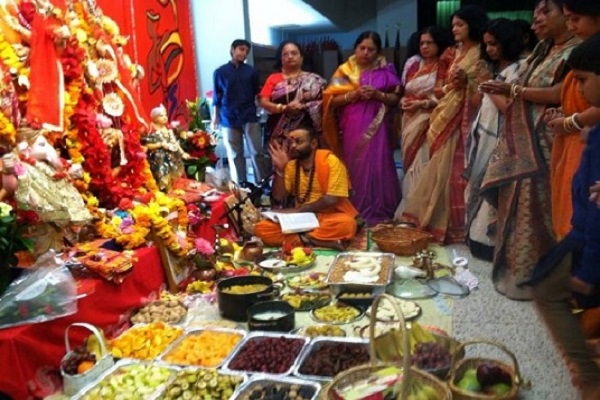
The Hindu theory of the idol is in sharp contrast with that of the Greek. In the former human form is merely the ephemeral clothing of the soul, in which, unhappily, it is forced to linger for a time. Though in the sculptures of the age of Asoka an interest in portraiture, at least in that which represents national characteristics, begins to appear, the childlike naturalism, somewhat refined in the delineation of woman, tends to become rococo in style. As idol-worship advanced, from the 7th or 8th cent., energy exhibited itself in gigantic images, or was expressed in a multiplication of the limbs or symbols of the deity. It is a mistake to suppose that idolatry was introduced into India by the example of the Greeks, and that it was rarely practiced until the beginning of the Christian era. Images of the gods were certainly common in the Maurya period (321-184 B.C.), and doubtless at a much earlier time; but of these ancient images none has survived. In the modern idol, the rigid conservatism of the race limits artistic invention as the forms become stereotyped; and the growth of aestheticism has exercised little influence on the development of the Hindu image.
The luxuriance of modern idol-worship is best observed at the most important holy places. At 1868, Sherring estimated that there were 1454 temples in Benares; and this enumeration did not include the minor shrines and wall-niches, each containing one or more images, which are found everywhere in the streets. These inferior shrines were, on one occasion, by a curious contrivance immensely increased; and yet the increase could hardly have been generally perceived. Raja Man Singh of Jaipur, wishing to present a hundred thousand temples to the city, made the stipulation that they were all to be commenced and finished in a single day. The plan hit upon was to cut out in blocks of stone a great many tiny carvings, each one representing a temple. The separate blocks, on the work being completed, exhibited from top to bottom, and on all sides, a mass of minute temples. These blocks are still to be seen in various parts of Benares. ... In regard to the number of idols of every description actually worshipped by the people, it certainly exceeds the number of people themselves, though multiplied twice over; it cannot be less than half a million, and may be many more. 37
Purusharthas (objectives of human life)
Classical Hindu thought accepts four proper goals or aims of human life: Dharma, Artha, Kama and Moksha. These are known as the Puruṣarthas. 38
Dharma (righteousness, ethics)
Dharma is considered the foremost goal of a human being in Hinduism. The concept Dharma includes behaviours that are considered to be in accord with rta, the order that makes life and universe possible, and includes duties, rights, laws, conduct, virtues and "right way of living". Hindu Dharma includes the religious duties, moral rights and duties of each individual, as well as behaviours that enable social order, right conduct, and those that are virtuous. 39 Dharma, according to Van Buitenen, is that which all existing beings must accept and respect to sustain harmony and order in the world. It is, states Van Buitenen, the pursuit and execution of one's nature and genuine calling, thus taking on one's role in cosmic concert. 40
The Brihadaranyaka Upanishad 41 states it as:
Nothing is higher than Dharma. The weak overcomes the stronger by Dharma, as over a king. Truly that Dharma is the Truth (Satya); Therefore, when a man speaks the Truth, they say, "He speaks the Dharma"; and if he speaks Dharma, they say, "He speaks the Truth!" For both are one.42
Artha (livelihood, wealth)
Artha is a polymorphous concept. It literally means “thing, object, and substance.” In the context of the purusharthas, Artha connotes profit, worldly advantage, and political, business, and professional success of all sorts. A study of Indian thought since Vedic times bear ample evidence that Artha is sometimes glorified, at other times given a lower importance, but never neglected. Vedic, Brahminical, and Mimamsa thoughts gave Artha the utmost importance, because without wealth one cannot perform rituals and sacrifices and discharge one’s obligations to the gods, forefathers, and society. Upanishadic and Vedantic thought, however, relegated it to a lower position. The Smriti literature (e.g., the epics and the Dharma literature) gave Artha equal importance along with Kama and Dharma. The Laws of Manu state that Dharma, Artha, and kama have equal value and that one should aim at all of them without neglecting any one of them. Artha is considered a purushartha not only because humans naturally want to acquire wealth, but because, in the absence of artha, a Hindu cannot perform his religious duties such as the performance of rites and rituals, feeding renouncers, and engaging in charitable activities, which are all obligations for people in the householder stage of life. 43 The Artha concept includes all "means of life", activities and resources that enables one to be in a state one wants to be in, wealth, career and financial security. The proper pursuit of artha is considered an important aim of human life in Hinduism. 44
Kama
Likewise, Artha, Kama is difficult to define. In the broadest sense, Kama refers to desire as well as the object of desire. In a narrow sense, however, Kama denotes erotic or sexual love, a desire for carnal gratification. In the Mahabharata, Kama is defined as pleasure derived from both sensuous and intellectual/emotional exercise. Vatsyayana, the author of the Kama Sutra, defines Kama as the enjoyment of appropriate objects by the five senses of hearing, feeling, seeing, tasting,
Mokṣa (liberation, freedom from samsara)
Moksha or mukti is the ultimate, most important goal in Hinduism. In one sense, Moksha is a concept associated with liberation from sorrow, suffering and saṃsara (birth-rebirth cycle). A release from this eschatological cycle, in after life, particularly in theistic schools of Hinduism is called Moksha. 46 In other schools of Hinduism, such as monistic, moksha is a goal achievable in current life, as a state of bliss through self-realization, of comprehending the nature of one's soul, of freedom and of "Realizing the whole universe as the Self". 47
Karma and Samsara
In the Brihadaranyaka Upanishad, a sage named Yajnavalkya taught that when a person dies and the senses gradually cease to function, the atman leaves the body and moves on to a new one. The moral quality of a person’s actions determines where the Atman will go—good actions lead to a better rebirth, bad actions to a worse one. Yajnavalkya linked action to desire, because desire motivates people to act to satisfy their desires. Their actions, then lead to rebirth in either this world or some other world. But a person who does not have desires instead returns to Brahman.
These ideas in the Upanishads are the basis of the doctrine of karma, which later Indian thinkers elaborated on more. The word karma literally translated as action, work, or deed, and also refers to a Vedic theory of "moral law of cause and effect". The theory is a combination of (1) causality that may be ethical or non-ethical; (2) ethicization, that is good or bad actions have consequences; and (3) rebirth.48 The particular nature of an action, whether good or bad, determines whether the “fruits” of the action will ripen, or achieve fruition, in this or another lifetime. What happens to the Atman at death is determined by whatever actions have not yet ripened or had an effect. From one lifetime to the next, the Atman is confined within particular bodies—animal, human, even divine—each rebirth being determined by karma. In some Upanishads, this cycle of death and rebirth is called Samsara. A person’s movement through Samsara is governed by karma, and escape from Samsara, known as Moksha, is possible through direct knowledge of the Atman. Once a person recognizes the Atman as his or her true identity, desires cease, and the Atman merges back into brahman rather than being born again.
The idea that people tend to maintain a false sense of self and therefore remain ignorant of their true identity runs through the Upanishads and much later Hindu thought. People identify themselves by name, family status, family, occupation, and social class rather than by the eternal Atman. They allow their actions to be dictated by various desires generated by this false and ultimately impermanent sense of identity. Yajnavalkya taught that knowledge of the Atman comes to the person who has no desires. But how is it possible to rid oneself of desires? People, after all, desire the most basic things—food, water, clothing, shelter, the welfare of their family, the company of others. If simply pursuing the most basic needs binds a person to Samsara or the cycle of death and rebirth, how can one live? The answer lies in a variety of techniques that came to be known as yoga. In its most basic sense, yoga means joining, harnessing, or yoking things together; yoga and the English word “yoke” have the same origin. 49
Practices
Most Hindus observe religious rituals at home. The rituals vary greatly among regions, villages, and individuals and are not mandatory in Hinduism. The nature and place of rituals are an individual's choice. Devout Hindus perform daily rituals such as worshiping at dawn after bathing (usually at a family shrine, and typically includes lighting a lamp and offering foodstuffs before the images of deities), recitation from religious scripts, singing devotional hymns, yoga, meditation, chanting mantras and others.
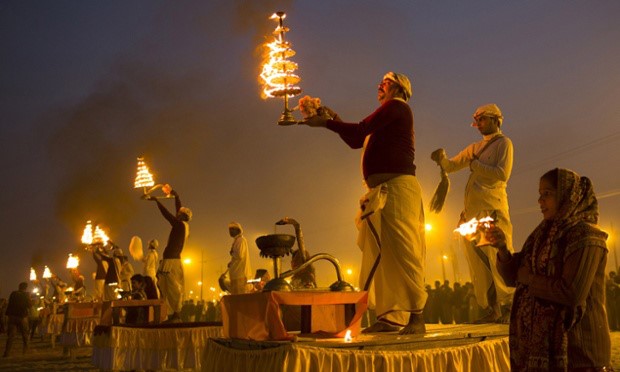
Vedic rituals of fire-oblation (yajna) and chanting of Vedic hymns are observed on special occasions, such as a Hindu wedding. 50 The other main life-stage events, such as rituals after death, include the yajna and chanting of Vedic mantras.
Sanskara
Major life stage milestones are celebrated as Sanskara (rites of passage) in Hinduism. The rites of passage are not mandatory, and vary in details by gender, community and region. Gautama Dharmasutras composed 48 Sanskaras in about the middle of the 1st millennium BCE, while Gryhasutra and other texts composed centuries later list between 12 and 16 Sanskaras. The list of Sanskaras in Hinduism includes both external rituals such as those marking a baby's birth and a baby's name giving ceremony, as well as inner rites of resolutions and ethics such as compassion towards all living beings and positive attitude. 51
According to Manu, the great lawgiver the personal Sanskaras are thirteen, from conception to death. Beginning with the marriage ceremony they are:
- Consummation. (Garbhadhana)
- Sanctification of the embryo. (Pumsavana)
- Rites for a safe delivery. (Simantonnayana)
- Birth rites. (Jatakarma)
- Naming ceremony. (Namakarana)
- First outing. (Niskramana)
- Weaning. (Annaprasana)
- Tonsure (first shaving of head) (Chudakarma)
- Initiation. (Upanayana)
- First shaving of the face. (Kesanta)
- Graduation. (Samavartana)
- Marriage. (Vivaha)
- Final rites. (Antyesthi)
In contemporary times, there is regional variation among Hindus as to which of these sanskaras are observed; in some cases, additional regional rites of passage such as Sraddha (ritual of feeding people after cremation) are practised.
Bhakti (worship)
Bhakti refers to devotion, participation in religious activities and the love of a personal god or a representational god by a devotee. Bhakti Marga is considered in Hinduism as one of many possible paths of spirituality and alternate means to Moksha. The other paths, left to the choice of a Hindu, are Jnana Marga (path of knowledge), Karma Marga (path of works), Rāja Marga (path of contemplation and meditation).
Bhakti is practised in many ways, ranging from reciting mantras, Japas (incantations), to personal, private prayers within one's home or in a temple or near a river bank, sometimes in the presence of an idol or an image of a deity. 52 Bhakti is sometimes practised as a community, such as a Puja, Aarti, musical Kirtan or singing Bhajan, where devotional verses and hymns are recited by a group of devotees or individuals. While the choice of the deity is at the discretion of the Hindu, the most observed traditions of Hindu devotional include Vaishnavism (Vishnu), Shaivism (Shiva) and Shaktism (Shakti).53 A Hindu may worship multiple deities, all as henotheistic manifestations of the same ultimate reality, universal spirit and entire spiritual concept called Brahman in Hinduism. 54
Puja
The most important ritual activity in contemporary Hinduism is called Puja. Puja is practised in both homes and temples, by both priests and ordinary people. Puja is a daily ritual, but it is also incorporated into annual festivals. In the temple, Puja is performed by the priests (pujari) on behalf of the devotees. However, it is not a congregational form of ritual and will be conducted regardless of the presence of the devotees. In some wealthy households, a priest might be employed to carry out the puja. Puja can also be performed without the intermediary of a ritual specialist. It is done before an image placed in a home or a shop. This may well simply be a brightly coloured picture from the bazaar. In the temples however, these pictures might be carved out of stone or wood, or cast in bronze.
Puja involves making ritual offerings to an image. This may be very simple – such as lighting some incense and waving it before an image in a domestic shrine – or immensely complex and involved, with the offering of a broad range of different objects while reciting the hymns. Shortened forms do not mean that the puja is considered as being incomplete in any way. In fact, it is common practice to shorten and simplify the ritual. For example, at dawn or dusk, the ritual may be reduced even more. A tray with burning camphor or an oil light is waved before the image of the deity while the devotees chant a mantra. This simplified ceremony is termed Aarti. As Fuller observes, ‘ritual abbreviation and simplification are ubiquitous procedures’ and this simple waving of a flame before the image is considered to be effectively performed the complete ritual. At the end of the Puja or Aarti, the priest will present the oil lamp or burning camphor, and the devotee will cup their hands around the flame and then bring their hands up to their forehead. A red powder made from turmeric (kumkum) or the ash from the burning incense will also be offered. The devotee will then mark the centre of their forehead with it.
The offering of food to the deity is a common feature of daily worship. This might involve some sweets, or an elaborate meal. This food is then distributed amongst the priests and the devotees. The Sanskrit term bhoga means the enjoyment of the sense objects; more specifically, it means food. By offering food to the deity, it transforms into Prasad, which means ‘grace’. In other words, the food becomes a symbol of the grace of the deity instead of being simply an enjoyable indulgence. The flame, the red powder or incense ash, and the Prasad are believed to be in contact with the deity in the form of the image. So, cupping the hands in the flame, marking the forehead and eating the Prasad all symbolise the transfer of divine grace to the devotee. 55
Festivals
There are a significant number of Hindu religious festivals held throughout the world. A festival may be observed with acts of worship, offerings to deities, fasting, feasting, vigil, rituals, fairs, charity, celebrations, Puja, Homa, Aarti and so on. The festivals typically celebrate events from Hindu mythology, often coinciding with seasonal changes. There are many festivals which are primarily celebrated by specific sects or in particular regions of the Indian subcontinent.
List and descriptions of major Hindu festivals
MAKAR SANKRANTI or PONGAL
Makar Sankranti or Pongal marks the transition of the Sun into Makar Rasi. It marks the gradual increase of the duration of the day.
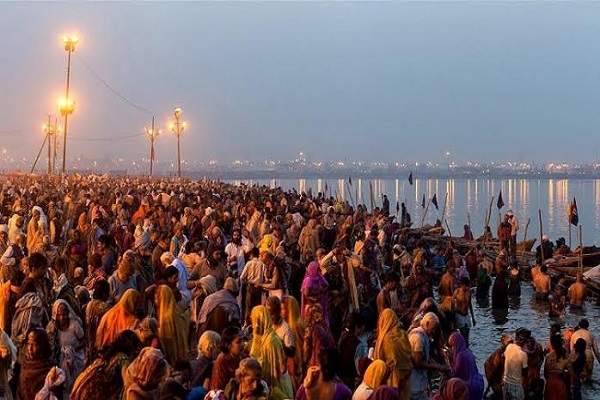
Thai Pongal in Colombo
Pongal is the first day of Uttarayana and coincides with the beginning of the Tamil month of Thai. Pongal is one of the most popular harvest festivals of southern India, mainly Andhra Pradesh, Telangana, Tamil Nadu and Karnataka.
Pongal occurs in the middle of January every year and marks the auspicious beginning of Uttarayan (sun's journey northwards). The Pongal festival lasts for four days.
VASANT PANCHAMI
It is the fifth day of the waxing moon of Magh (Hindu calendar).
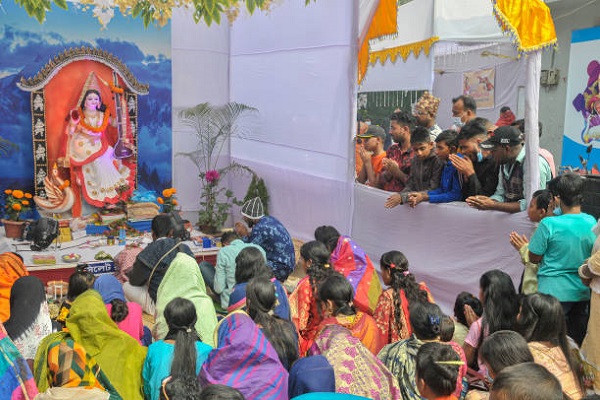
Goddess Saraswati in Kolkata
Vasant Panchami (also called Saraswati Puja by Bengalis and Odias) is celebrated for the blessing of Saraswati, the goddess of wisdom and the arts.
THAIPUSAM or KAVADI
Thaipusam is a Hindu festival celebrated mostly by the Tamil community. The word Thaipusam is derived from the Tamil month name Thai and Pusam, which refers to a star near the location of the moon during the festival. The festival commemorates the occasion when Parvati gave Murugan a spear so he could vanquish the evil demon Soorapadman.
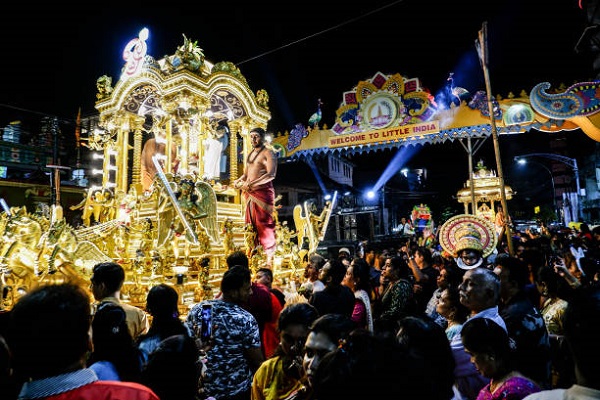
Murugan during Thaipusam
Kavadi Attam is a dance performed by the devotees during the ceremonial worship of Murugan, the Tamil God of War. It is often performed during the festival of Thaipusam and emphasises debt bondage. The Kavadi itself is a physical burden through which the devotees implore for help from the God Murugan.
MAHA SHIVARATRI
It is observed on the thirteenth night of the waning moon of Magh (Hindu calendar).
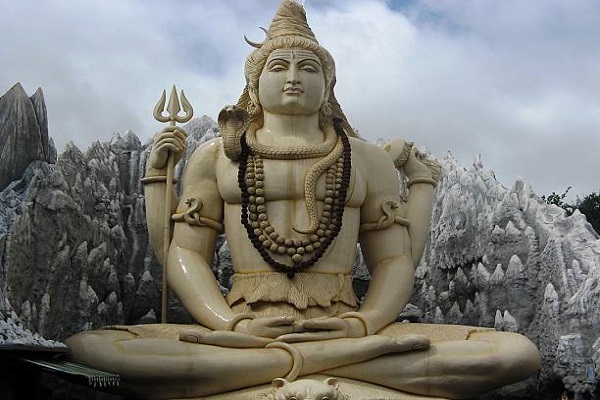
Statue of Shiva meditating
Maha Shivaratri is the great night of Shiva, during which followers of Shiva observe religious fasting and the offering of Bael (Bilva) leaves to Shiva. Mahashivaratri Festival or the ‘The Night of Shiva’ is celebrated with devotion and religious fervour in honour of Lord Shiva, one of the deities of Hindu Trinity. Shivaratri falls on the moonless 14th night of the new moon in the Hindu month of Phalgun, which corresponds to the month of February - March in English Calendar. Celebrating the festival of Shivaratri devotees observe day and night fast and perform ritual worship of Shiva Lingam to appease Lord Shiva. To mark the Shivratri festival, devotees wake up early and take a ritual bath, preferably in river Ganga. After wearing fresh new clothes, devotees visit the nearest Shiva temple to give a ritual bath to the Shiva Lingum with milk, honey, water, etc. On Shivaratri, worship of Lord Shiva continues all through the day and night. Every three hours priests perform ritual Pooja of Shivalingam by bathing it with milk, yoghurt, honey, ghee, sugar and water amidst the chanting of “Om Namah Shivaya’ and ringing of temple bells. Nightlong vigil or jargon is also observed in Shiva temples where a large number of devotees spend the night singing hymns and devotional songs in praise of Lord Shiva. It is only on the following morning that devotee breaks their fast by partaking Prasad offered to the deity.
HOLI
It is observed on the full moon of the Phalgun month (Hindu calendar). Holi or Phagwah is a popular spring festival. Holi commemorates the slaying of the demoness Holika by Lord Vishnu's devotee Prahlad. Thus, the festival's name is derived from the Sanskrit words "Holika Dahanam", which mean "Holika's slaying". The festival is called Shigmo and Shimga in Goa and rural Maharashtra respectively.
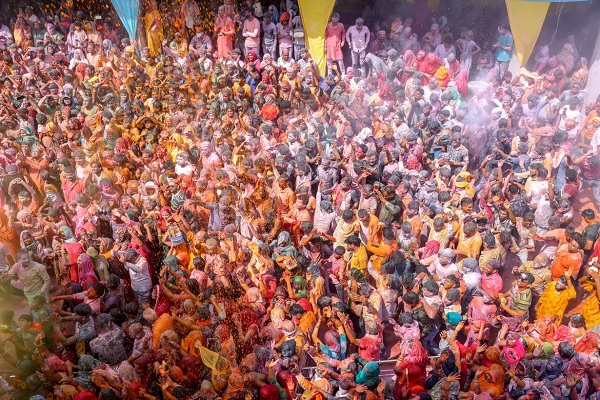
Holi
SHIGMO
Shigmo is celebrated in Goa as one of the prominent festivals of the Konkani Hindu community.
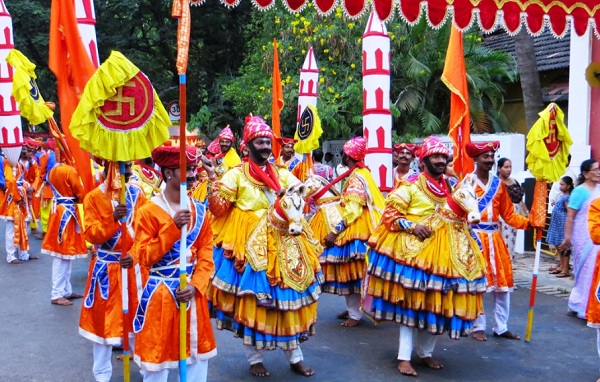
Shigmo
RANG PANCHAMI
In Maharashtra and parts of Madhya Pradesh, the festival of colours is celebrated five days after Holi on Rang Panchami.
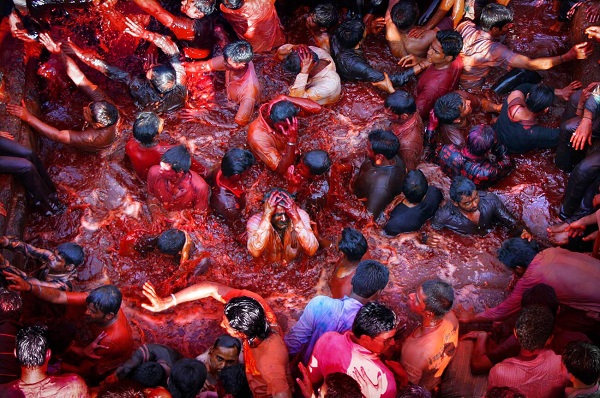
Rang Panchami in Maharashtra
GANGAUR
"Gangaur" is the colourful and one of the most important festivals of people of Rajasthan. It is observed throughout the state with great fervour and devotion by womenfolk who worship Gauri, the consort of Lord Shiva during March–April.
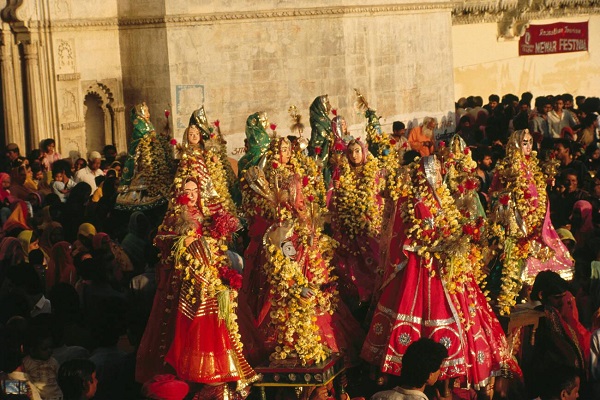
Mother Gaur
VASANT NAVRATRI
Navratri is the Hindu festival of worship and dance. In Sanskrit, the term means "nine nights". During this festival, the forms of Shakti are worshipped, and effigies are burned
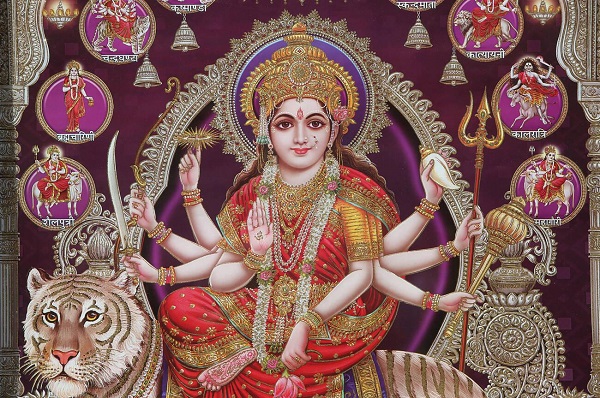
Vasant Navratri
RAMA NAVAMI
Rama Navami is the celebration of the birth of Rama. Rama Navami is the day on which Lord Rama, the seventh incarnation of Lord Vishnu, incarnated in human form in the land of Ayodhya. He is the ardha ansh of Vishnu or has half the diminutive qualities of Lord Vishnu. The word “Rama” literally means one who is divinely blissful and who gives joy to others, and one in whom the sages rejoice. Ram Navami falls on the ninth day of the bright fortnight of the month of Chaitra (April/May) and coincides with Vasant Navratri or Chait Durga Puja. Therefore, in some regions, the festival is spread over nine days. This day, marking the birthday of Lord Rama is also observed as the marriage day of Rama and Sita and thus also referred to as Kalyanotsavam. In Ayodhya, the birthplace of Lord Rama, a huge fair is held by thousands of devotees gathering to celebrate this festival. The fair continues for two days, and rathyatras, carrying the Deities of Ram, his brother Laxman, His wife Sita, and His greatest devotee Mahavir Hanuman, are taken out of almost all Ram Temples. Hanuman is known for is his devotion to Rama, and his tales form an important part of the celebration. In Andhra Pradesh, Ram Navami is celebrated for ten days from the Chaitra Saptami to the Bahula Padyami that fall in the month of March and April. Temples re-enact the marriage of Lord Rama and Sita to commemorate this event since this day is also the day they got married.
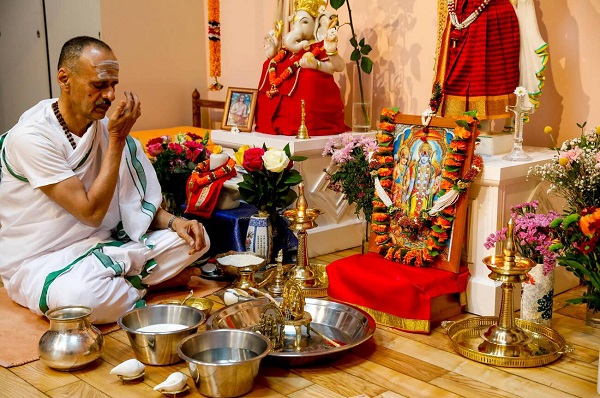
Ramnavami
GUDI PADWA, CHETICHAND
It is observed on the first day of waxing moon of Chaitra (Hindu calendar).
Gudi Padwa / ChetiChand is celebrated on the first day of the Chaitra month and is celebrated as New Year's Day by Marathis, Konkanis and Sindhis. According to the Brahma Purana, this is the day on which Brahma created the world. The date keeps changing every year in the month of March.
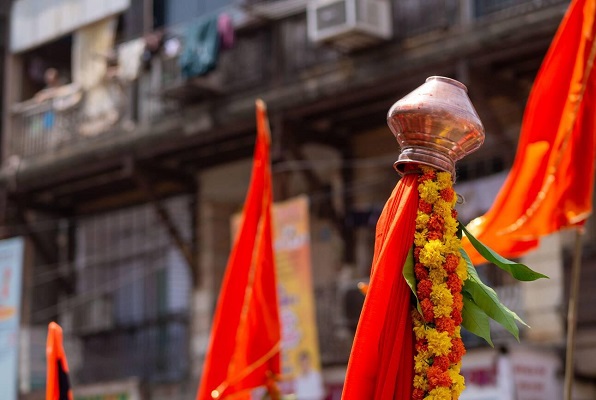
Traditional Gudhi Navami
UGADI
Ugadi (meaning "the start of an era" in Kannada) is New Year's Day for the Kannadigas and Telugus. It takes place on the same day as Gudi Padwa.
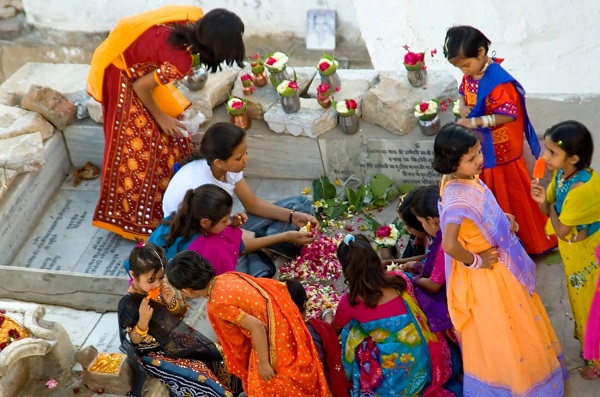
Group of Indian children preparing flowers for the Ugadi festival
MESHA SANKRANTI
Observed on the first day of the solar month of Vaisakha.
Record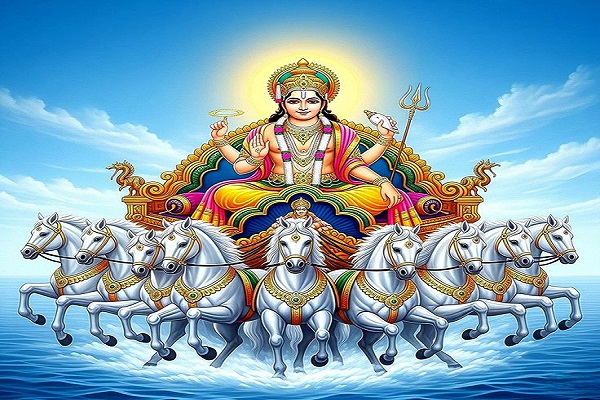
Mesha Sankranti
Mesha Sankranti (also called Vaisakha Sankranti) represents the transition of the sun into the Mesha (Aries) Zodiac. It marks the start of the solar new year in lunisolar calendars. Involves bathing in the holy waters. Regional new year festivals are also observed on this day such as Vishu, Pohela Boishakh and Vaisakhi. Represents the vernal (Spring) equinox.
VISHU
Vishu is a Hindu festival celebrated in Kerala. It falls around 14th April of the Gregorian year.
TAMIL NEW YEAR
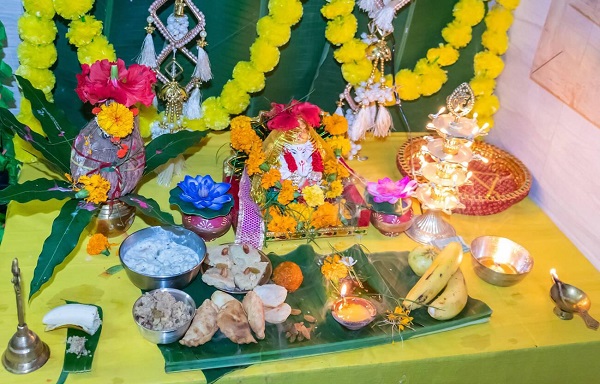
Vishu
The Tamil New Year follows the Narayan vernal equinox. It falls around 14th April of the Gregorian year.
BIHU
Observed on the Vaisakha/Bohag (Assamese calendar) – The first month of Hindu calendar.
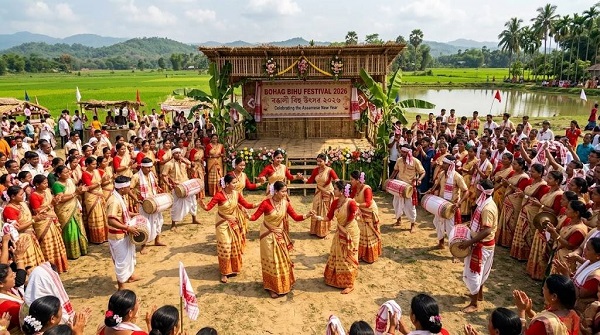
Bihu
Rongali Bihu (mid-April, also called Bohag Bihu), the most popular Bihu celebrates the onset of the Assamese New Year (around 15 April) and the coming of Spring.
HANUMAN JAYANTI
Hanuman Jayanti is the celebration of the birth of Hanuman, Rama's loyal devotee. To mark the birth of Lord Hanuman, Hanuman Jayanti is celebrated all over India in the month of Chaitra in Hindu calendar. The great Hanuman is known for its high strength, power and his everlasting devotion towards Lord Rama. He is considered to be the greatest follower of Lord Rama and played a crucial role in his life. He is also known as Sankat Mochan whom people remember in both good and bad times. He is considered to be as one of the most powerful Hindu gods in India. According to Hindu mythology, as the son of 'Pawan', the God of Winds and 'Anjanee' often referred to as 'Pawanputra,' is blessed with immense physical and mental strength that is greatly inspiring. Celebrations on Hanuman Jayanti began early in the day with special Puja being performed by devotees. Devotees perform holy Puja in temples dedicated to Sree Hanuman or at Home. People in India organise special prayers for Lord Hanuman to get rid of evil spirits. The God is known for its magical powers. Prayers and Hymns are sung all day long in various Hanuman temples dedicated to the Lord. Hanuman is considered as a symbol of Power and high strength in Hindu mythology. He is believed to have carried a whole mountain on his shoulder. On the auspicious day of Hanuman Jayanti, People apply red Sindur from Lord's feet on their foreheads. This is considering being a ritual for good health and good luck.
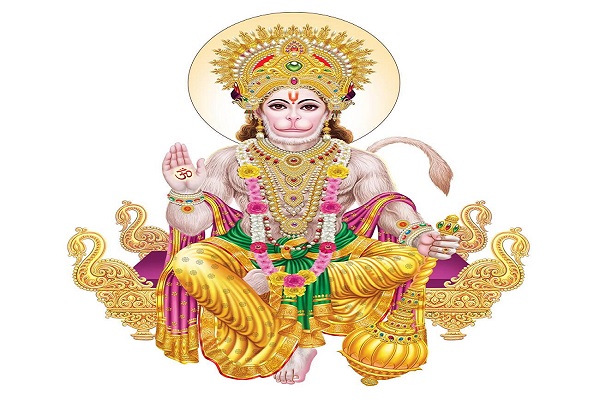
Shri Hanuman
SITALSASTHI
It is observed on the sixth day of the bright fortnight of the month of Jyestha (Hindu calendar)
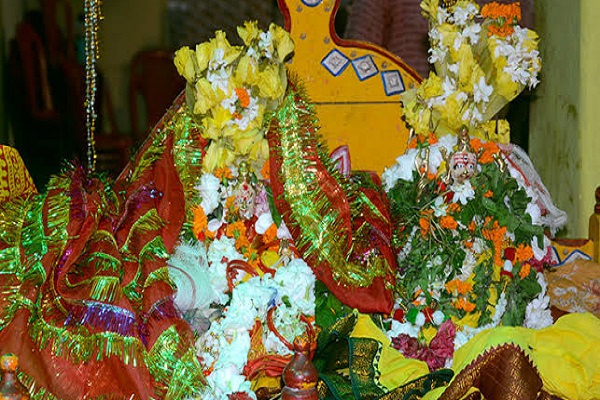
Sital Sasthi
The marriage of Shiva and Parvati is celebrated as Sitalsasthi. It is celebrated as a carnival, in which people and artists from different walks of life participate, making it more beautiful and bringing out the true colour of life.
VAT PURNIMA
It is observed on the Full moon of Jyeshta (Hindu calendar). Vat Purnima is observed in Maharashtra. Purnima means "full moon." Women pray for the prosperity of their husbands by tying thread around a banyan tree.
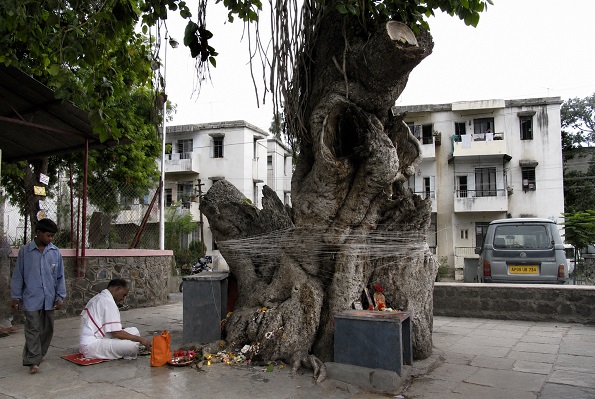
Tying threads around a banyan tree
BONALU
Bonalu is a festival celebrated for a Mother Goddess (such as the goddesses Pochamma, Yellamma, etc.) in the Telangana.
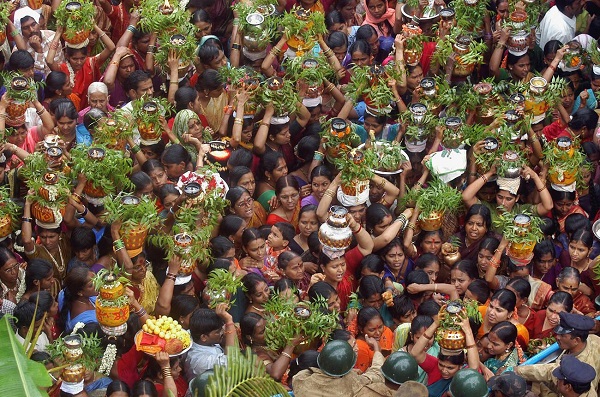
Women with Bonam performing
BATHUKAMMA
Bathukamma is a festival celebrated during the months of September and October in 10 districts of Telangana.
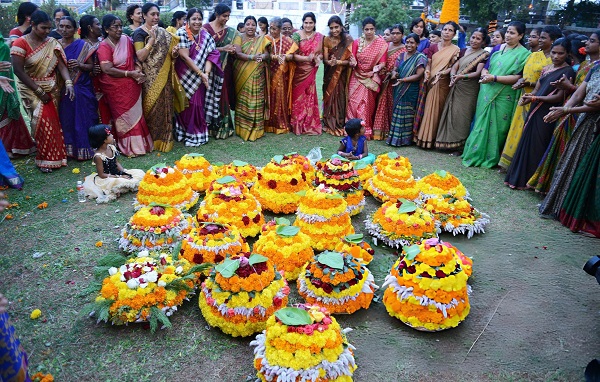
Women dancing around Bathukammas Parikrama (wata)
RATH YATRA
Rath Yatra is the festival associated with Jagannath.
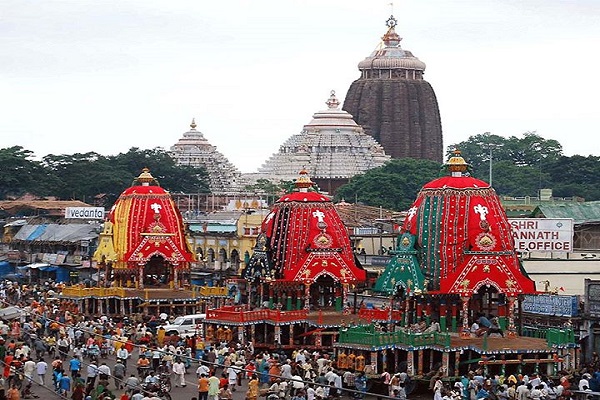
Rath Yatra
RAJA PARBA
It is observed on the second day (Raja Sankranti) which signifies the beginning of the solar month of Mithuna.
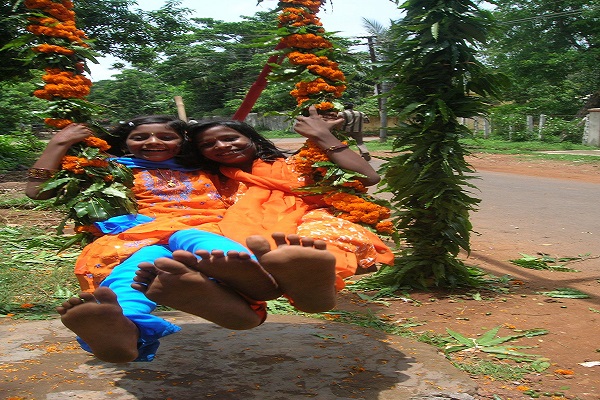
Raja Doli Khela, Oriya festimal
Raja Parba is a four-day-long festival. It inaugurates and welcomes the agricultural year all over Odisha.
GURU PURNIMA
Observed on the full moon of Ashadh (Hindu calendar).
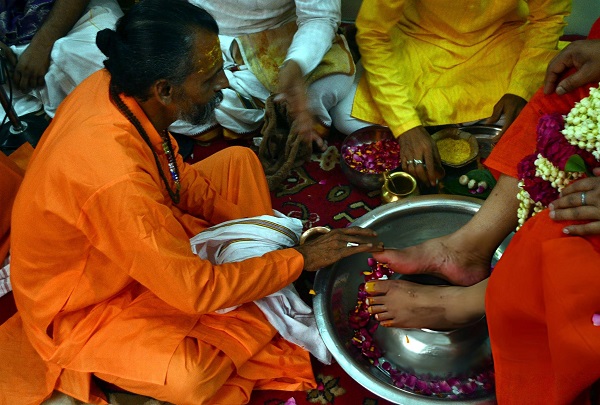
Guru Purnima is the day devotees offer Puja (worship) to their Guru. This was also the day when Vyasa, author of the Mahabharata was born.
MAHALAKSHMI VRATA
Mahalakshmi Vrata is a Puja performed by married Hindu women to seek the blessings of Mahalakshmi, the goddess of wealth and prosperity.
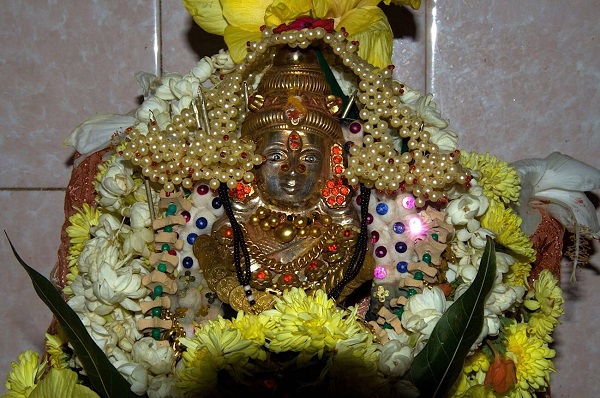
Mahalakshmi performing
ONAM
Onam is the harvest festival of Kerala. Though Onam is traditionally a Hindu festival celebrated in Kerala, contemporarily Onam is celebrated by the Kerala diaspora across the globe. Onam commemorates the rule of Mahabali, an Asura (demon) king who loved his subjects. During his rule, people were happy, honest and full of righteousness. Legend says Lord Vishnu took the incarnation of Vamana, a dwarf Brahmin who visited Mahabali seeking three steps of land for sitting in self-denunciation. Cleverly Vamana defeated Mahabali and sent him to the netherworld. Onam is the annual homecoming of the legendary Emperor Mahabali. It falls during the month of Chingam (August–September) and lasts for ten days. The festival is marked by various festivities, including intricate flower carpets; elaborate banquet, lunches, snake boat races, Onappottan, Kaazhchakkula in Guruvayoor, Puli Kali, Kaikottikkali, etc. These festivities make Onam a unique festival of the earth, which is embellished by a number of cultural elements, and it can be undoubtedly said that these elements constitute the colorfulness, diversity and richness that no other festival can claim. On Onam day people conduct special prayers in Hindu temples. Although Prayers in Hindu temples are an important part of the festival, non-Hindus are not allowed to enter temples.
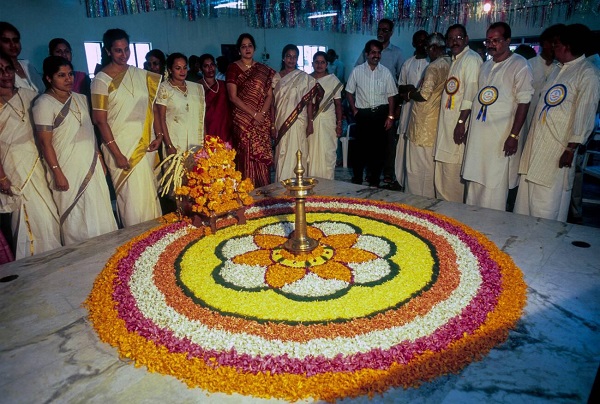
Onam
RAKSHA BANDHAN
It is observed on the full moon of Shravana (Hindu calendar).
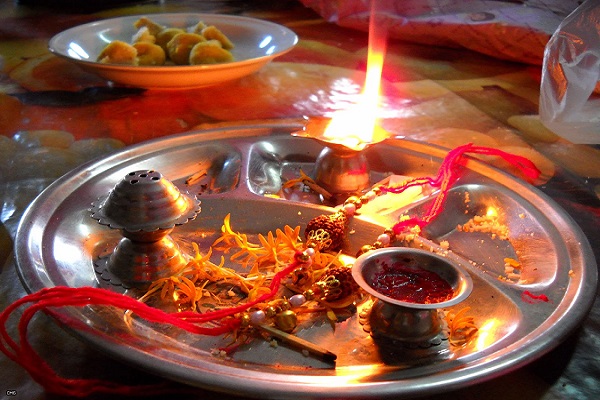
Rakhis Mahalakshmi
Raksha Bandhan is a festival celebrated mainly in the northern Indian states. Rakhi is a special occasion to celebrate the chaste bond of love between a brother and a sister.
TEEJDI
Observed on the third day after Raksha Bandhan.
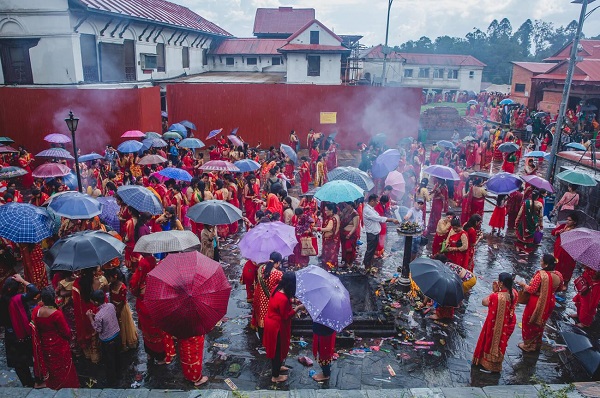
Teejdi
"Teejdi" is a festival of Sindhis. On this day Sindhi ladies observe a day-long fasting for longer life of their husbands. They take dinner after "Chandra Darshan" i.e. seeing Moon.
KRISHNA JANMASHTAMI
Observed on the eighth day of waning moon of Bhadrapad (Hindu calendar).
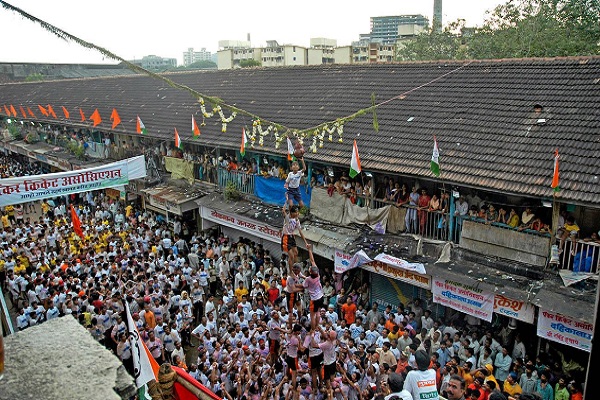
Govinda Pathaks forming a human
Krishna Janmashtami is the Hindu festival celebrating the birth of Krishna. It is called as Krishna Jayanthi. The date falls not only on the eighth day of the waning moon of Bhadrapad but always on Rohini Nakshatra. Janmashtami, the birthday of Lord Krishna is celebrated with great devotion and enthusiasm in India in the month of July or August. According to the Hindu calendar, this religious festival is celebrated on the Ashtami of Krishna Paksh or the 8th day of the dark fortnight in the month of Bhadon. Sri Krishna is considered as one of the most powerful human incarnations of the Lord Vishnu. He was born around 5,200 years ago in Mathura. The sole objective of Sri Krishna's birth was to free the Earth from the evilness of demons. He played a major role in the Mahabharata and propagated the theory of Bhakti and good karma which are narrated deeply in the Bhagwat Geeta. Sri Krishna was born in prison in the custody of Kansa. Vasudev, His father, immediately thought of his friend Nand and decided to hand over his child to him to save Krishna from the clutch of Kansa. Krishna grew up in Gokul and finally killed his uncle, King Kansa. The actual celebration of Janmashtami takes place during the midnight as Sri Krishna is believed to be born on a dark, stormy and windy night to end the rule and violence of his uncle, Kansa. All over India, this day is celebrated with devotional songs and dances, pujas, arti, blowing of the Conch and rocking the cradle of baby Sri Krishna. The Janmashtami celebration of Mathura and Vrindavan, the places where Sri Krishna had spent his life, are very special. On this day temples and homes are wonderfully decorated and illuminated. Night long prayers are offered, and religious mantras are sung in the temples.
RADHASTAMI
It is observed on the eighth day of waxing moon of Bhadrapad (Hindu calendar).
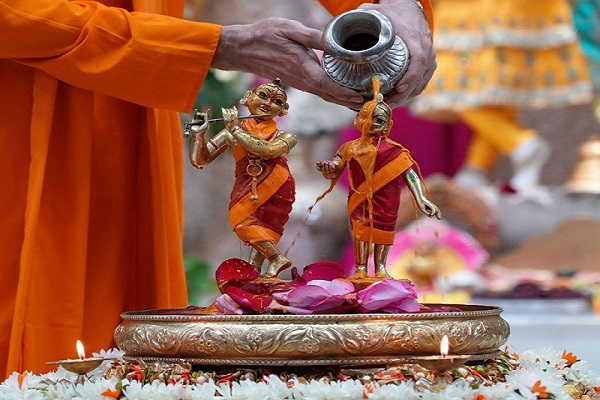
Radhastami
Radhastami is celebrated all across India, especially in Northern India on Bhadrapad Shukla Paksha Ashtami as the birth anniversary of Goddess Radha, the consort of Lord Krishna.
GOWRI HABBA
Gowri Habba is celebrated in Karnataka, Andhra Pradesh, and Tamil Nadu. Gowri is worshipped for her ability to bestow courage to her devotees. Newly wed couples are invited to the house of the groom's parents and served with varieties of food.
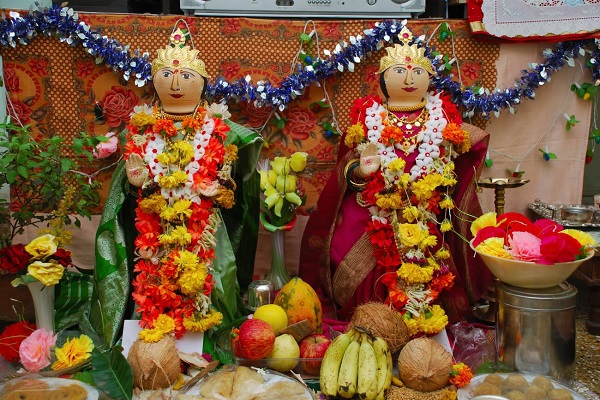
Gowri Habba
GANESH CHATURTHI
It is observed on the fourth day of the waxing moon of Bhadrapada (Hindu calendar).
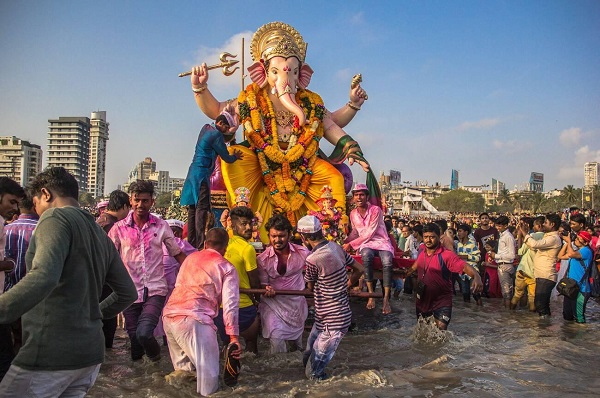
Ganesh Visarjan in Mumbai
Ganesh Chaturthi is celebrated as the arrival of Ganesh on the earth.
NUAKHAI
It is observed on the fifth day of the waxing moon of Bhadrapada (Hindu calendar).
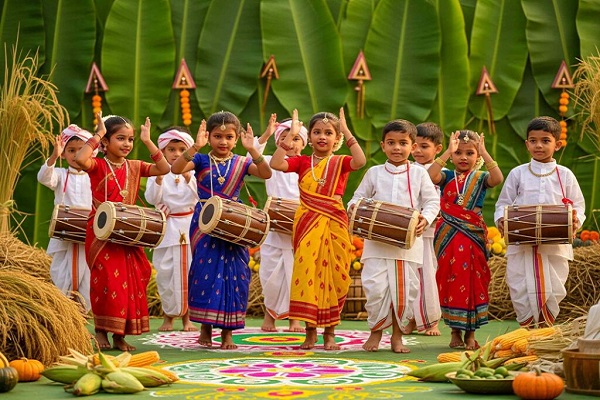
Nuakhai
Nuakhai is celebrated to welcome the new rice of the season. This is an agricultural festival mainly observed by people of western Odisha (Kosal).
NAVARATHRI
Observed on the first nine nights of the waxing moon of Ashvin, Navarathri is the Hindu festival of worship and dance. In Sanskrit, the term means "nine nights". During this festival, the forms of Shakti are worshipped. Literally “nine nights”, this nine – day period from the new moon day to the ninth day of Ashvin is considered the most auspicious time of the Hindu calendar and is hence the most celebrated time of the year. Although it has different names in different parts of India, Hindus from all regions celebrate it. From Kashmir in the North to Tamil Nadu in the South, and from Gujarat in the West to Sikkim in the East, it is celebrated with a high enthusiasm as the conquest of good over evil. Every region has its myths and reasons to explain this.
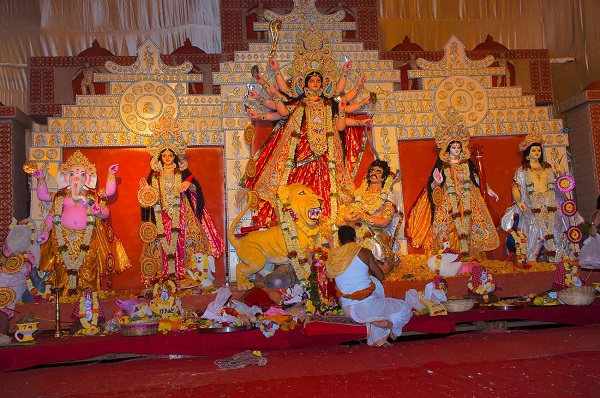
Navaratri
The nine different aspects of Devi are worshipped over the nine days. These are the most popular forms under which she is worshipped: Durga, goddess beyond reach; Kali, the auspicious power of time; Amba or Jagdamba, mother of the world; Annapurna, the giver of food and plenty; Sarvamangala, auspicious goddess; Bhairavi, terrible, fearful, power of death; Chandika or Chandi, violent, wrathful, furious; Lalita, playful; Bhavani, giver of existence; Tara, giver of success in work.
VIJAYADASHAMI
Observed on the tenth day of waxing moon of Ashvin (Hindu calendar), Vijayadashami is the Hindu celebration of good over evil.
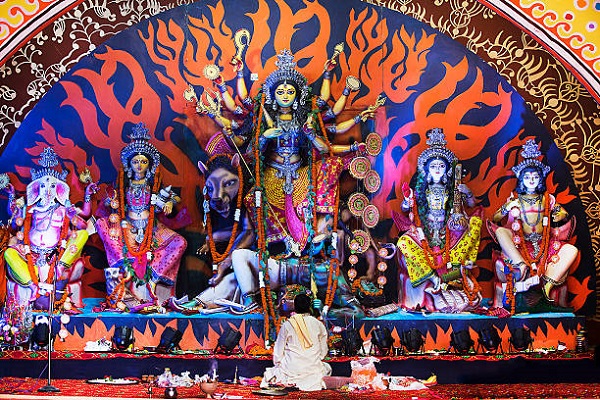
The Head priest performs Ashtami puja
DEEPAVALI
Observed on the new moon of Ashvin (Hindu calendar), Deepavali which means "row of lights/lamps" in Kannada and Telugu and Sanskrit is called "Diwali" in North India, Deepa means lamp, and in Hindi, a lamp is mostly called a Diya or Di. The festival is celebrated on the occasion of Lord Krishna and his wife Satyabhama killing a demon Narakasura. Another story says the festival is celebrated for the return of Rama and Sita to the kingdom Ayodhya after fourteen years of exile.
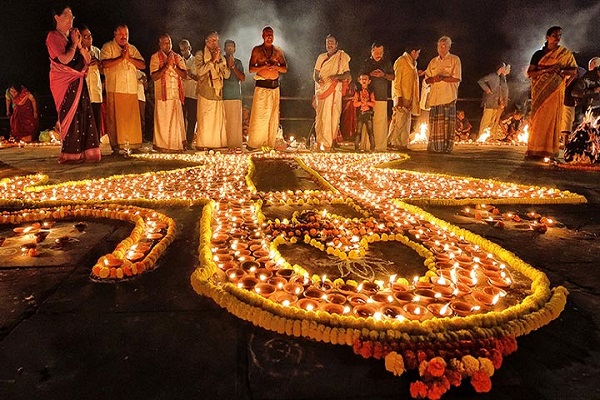
Rangoli decoration
Rama is exiled to the forest for 14 years, his devoted wife Sita and humble brother Laxman decide to join him, after 14 years the whole village know he is returning such light lamps or 'divas' to guide him, his wife and brother home. So every year lamps are lit to represent Rama finding his way back home after the harsh punishment of being sent to exile in the forest.
BHAI DOOJ
Observed on the second day of the waxing moon of Kartik (Hindu calendar), Bhai Dooj, also referred to as Bhaubeej, is the ceremony performed by Hindus, generally, on the second day of Deepavali. It is celebrated among brothers and sisters and is similar to Raksha Bandhan, except there is no tying of Rakhi involved.
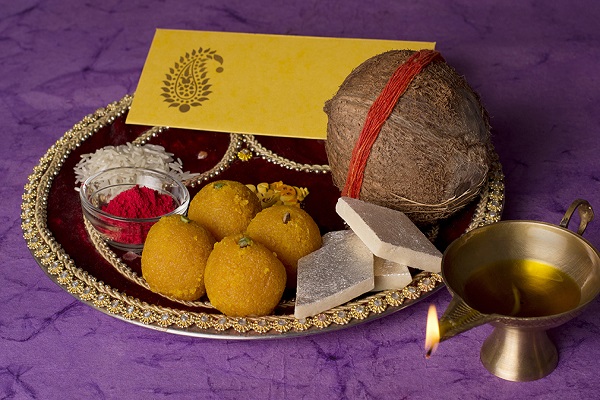
Bhai Dooj
KARTIK POORNIMA
It is observed on the 15th on the Full moon day of Kartik (November–December).
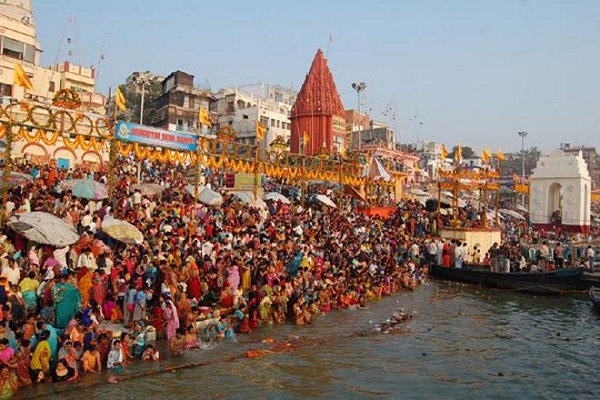
Kartik Poornima
It is a unique festival is celebrated in Varanasi this day, which is called Dev Devali. The Kartik Purnima festival also coincides with the Jain light festival and Guru Nanak Jayanti
CHHATH
Chhath is mainly observed in Bihar and Terai, but is also celebrated elsewhere. It is a festival dedicated to the Sun god for bestowing the bounties of life and fulfilling wishes.
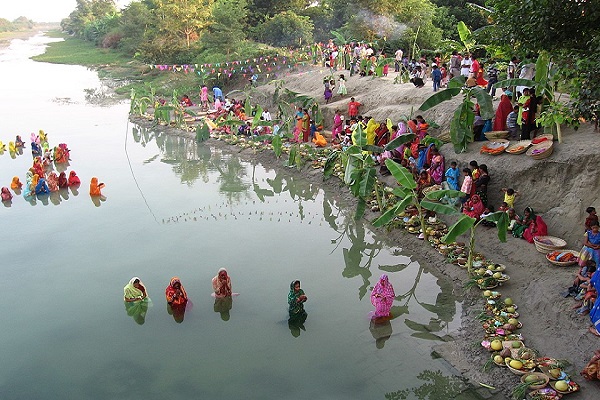
Morning worship
SKANDA SASHTI
Skanda Sashti is decided on a lunar month during the sixth day of Karthika Masam (October–November). It is one of the most important festivals dedicated to Lord Murugan the second son of Shiva. On this festival is celebrated the victory of Murugan against the Asuras.
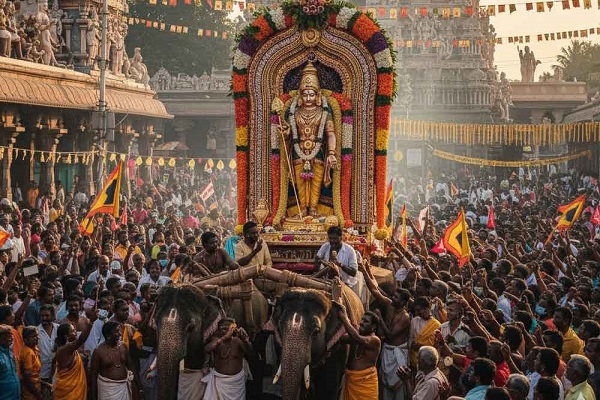
Skandha Sashti
PRATHAMASTAMI
Observed After eight days of Kartik Purnima, Prathamastami is a festival that originated in Odia. It is held on the eighth day of the month of Agrahayana when older female relatives pray for the prosperity of their eldest child. The festival is followed by rituals and recitations of the Glory of Mahalakshmi and Shashti Devi.
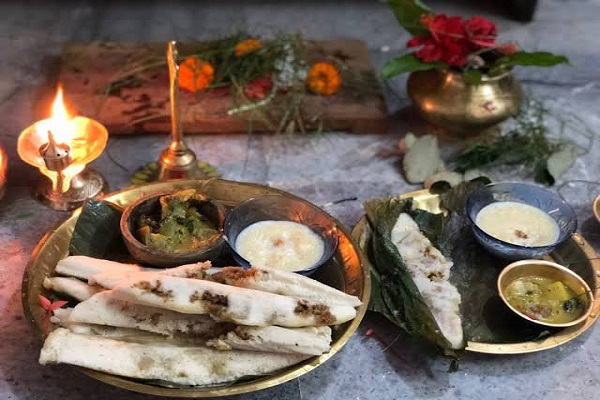
prathamastami
YATRA
Yatra (also Zatra and Jatra) refers to the pilgrimage festivals celebrated in Hindu temples. Idols and murtis are taken out in a special procession in a Palki (a palanquin), or a chariot called the rath. Every temple observes this festival once a year on a traditional day.
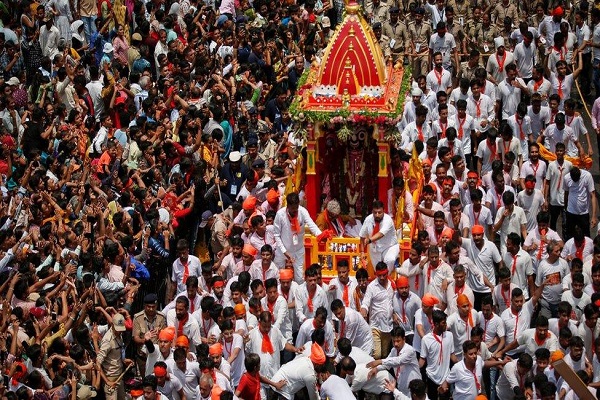
Dayaneshwar's Palki holding the footwear of the saint
KARTHIKAI DEEPAM
Karthikai Deepam is an ancient festival of lights celebrated by Tamil Hindus on the full moon day of Karthikai month (November/December). This occurs on the day when the moon is in conjunction with the constellation Karthigai (Pleiades) and Purnima. It is the same as Kartik Poornima; however, since Tamils follow the Hindu Solar calendar with correction for the precession of the equinoxes, the Tamil date matches the actual constellation.
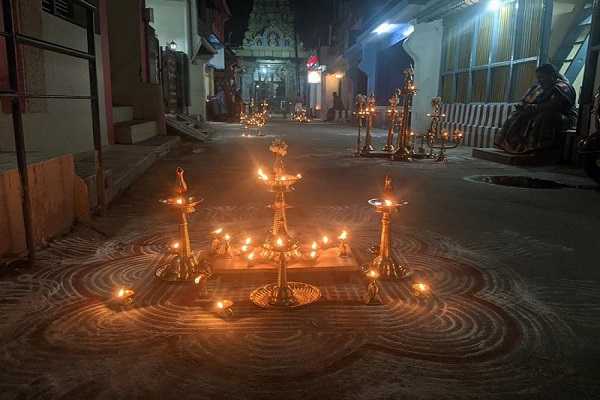
Pithalai vilakku during karthigai
PANCHA GANAPATI
A Winter Solstice celebration that lasts five days, Pancha Ganapati is a modern Hindu festival celebrating Lord Ganesha, the Five-Faced Maha Ganapati—Lord of Categories.
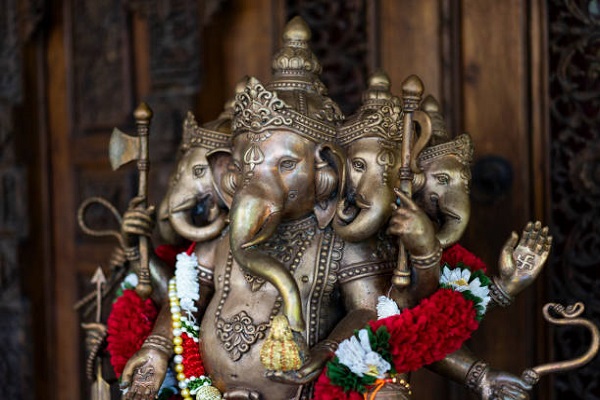
Pancha Ganapati
KUMBH MELA
It is a pilgrimage made every four years in the Ganges river.
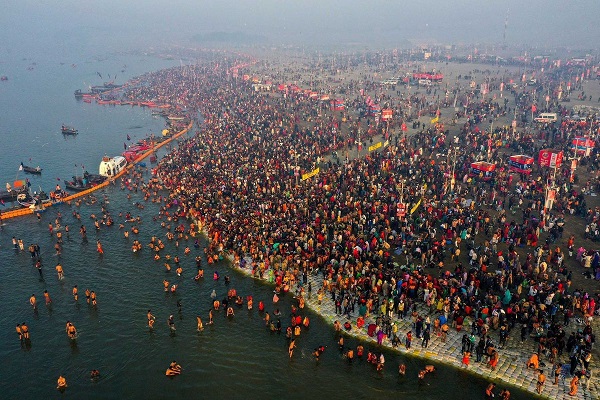
Kumbh Mela
The Purna (complete) Kumbh takes place every twelve years and is an ordinary massive Kumbh Mela. The Ardh (half) Kumbh Mella, a smaller Kumbh Mela, is celebrated every six years. The normal Kumbh Mela is celebrated every four years. The Maha (great) Kumbh Mela, a special large Kumbh Mela, occurs every 12 'Purna Kumbh Melas', or 144 years.
GODAVARI PUSHKARAM or PURNA KUMBHA MELA
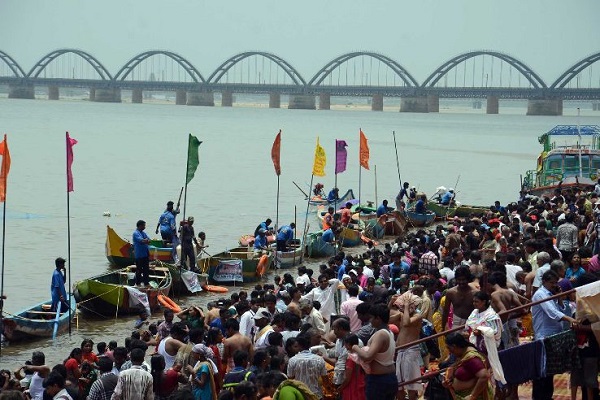
Arch Bridge Rajahmundry over the Godavari the Ganges
Godavari Pushkaram or Godavari Pushkaralu is most commonly stated as it is the festival of the river Godavari. The main significance of this Godavari Pushkaralu is that It occurs once in every 12 years, in other words called as Pushakara. The river Godavari took its birth at triambakeswar of Nasik which is located in Maharashtra state. It flows along the various regions of Telangana and Andhra Pradesh and finally flows into the Bay of Bengal.Maha Pushkaralu which comes once in 144 years.Main centre's that celebrate Pushkaram are Rajahmundry, Bhadrachalam, Trimbakeshwar & Nasik. Most of the Godavari River is connected with Rajahmundry, where it has widespread across the city. 56
Castes
Caste is one of the most pervasive and controversial aspects of life in India. It is found in most religions in India, including—Christianity and Sikhism. Only tribal people are totally outside the system. It is a form of graded inequality with a varied but distinct hierarchy wherever it exists. In some ways, it has been a factor in Indian society for at least 2,500 years.
The division of society into four distinct social orders exists in almost every civilised society. What differentiates the Western ‘class’ system from the Hindu ‘caste’ system is that in the West there is relative class mobility — meaning that with education and professional advancement one can move from one social order into another. Whereas in India it was/is tough, though not unknown to change from one caste to another, or for a whole caste to elevate itself. When observing any organised and structured society, we can distinguish clearly between four classes:
- The Intelligentsia (Brahmins) — the thinkers, teachers, poets, writers, scholars and intellectuals of the society.
- The Bureaucrats (Kshatriyas) — politicians, administrators, managers, executives, soldiers, police and all government officials.
- The Entrepreneurs (Vaishyas) — traders, businessmen, merchants, artisans, farmers etc.
- The Proletariat (Sudras) — unskilled and semiskilled workers, labourers, etc.
There are several levels of “Caste” which are lumped together. These are the social divisions based on one’s birth into a particular family — this is known as jati. Then there are the same four divisions based on one’s inherent character, regardless of family categorization, known as Varna. 57 The term refers to social classes in Brahminical books like the Manusmriti.] Then there is the further subdivision into vocation or occupation known as vritti. So, one may be born into a specific caste, with a character about another caste and work in a job unrelated to either. Caste as a method of social structuring is far more complex than simple racial segregation which was practised in America or South Africa. Caste in Indian society was like the professional guilds of Medieval Europe. Each one had its own administrative and ethical structure, and people married and kept the art or profession within the group/caste. Hinduism teaches that all jobs, occupations and professions are ‘callings’ and one should work in that profession which is suited to one’s character and abilities. There is no disgrace in menial work, and all work should ideally be done as service to God.
Inter‐caste social restrictions, in fact, applied only to intermarriage and interdining. These two activities were carried out only with people from the same or compatible castes. Though the caste system has many faults, still it is the force which has preserved the integrity of Sanatana Dharma over millennia. Sanatana Dharma has existed from time immemorial because of its social structure, despite all the attempts by invaders and foreigners to destroy it.
Through 800 years of war, conquest, repression and destruction of temples and religious institutes, Sanatana Dharma has survived. For 250 years, European Christian Imperialists have worked assiduously through aggressive indoctrination, enticement, legislation, force and deception to convert Hindus. However, compared to their successes with the rest of the world their attempts in India have failed dismally!
There are many facets of the caste system which are purely social in nature and are not sanctioned by the Dharma. There is much oppression and wickedness perpetrated in the name of the caste system. Today the caste system is practised in its rigid form only in the villages. Most expatriate Hindu communities know the system only in name and faint memory.
Untouchability
This is surely the greatest injustice which the caste‐system produced. The untouchables are the social groups who initially by their objectionable lifestyle (as scavengers, butchers, hunters, etc.) were excluded from social intercourse with the other Hindus. Later, as the system became entrenched, being born in the untouchable community was enough to earn the malevolence of other Hindus even if that person did not have a lowly lifestyle. This situation still exists in many parts of India to this day and one hastens to add is not a social convention that is supported by the religious institutions.
The earliest application to the formal division into four social classes (without using the term Varna) appears in the late Rigvedic Purusha Sukta (RV 10.90.11–12). It has the Brahman, Rajanya (instead of Kshatriya), Vaishya and Shudra classes emerging from the mouth, arms, thighs and feet at the sacrifice of the primordial Purusha, respectively:
11. When they divided Purusa how many portions did they make? What do they call his mouth, his arms? What do they call his thighs and feet? 12. The Brahman was his mouth, of both his arms was the Rajanya made. His thighs became the Vaishya, from his feet the Shudra was produced. 58
In the post-Vedic period, the Varna division is described as the Mahabharata and the Puranas in the Dharmashastra literature.
Ethics of Hinduism
The influence of Hinduism on life and character is a very broad subject. The supernatural beings of ancient belief frequently display the utmost indifference to questions of worldly morality; and in the early stages of the evolution of public justice, the community interferes only on supernatural grounds with actions which are regarded as endangering its own existence. In other words, sin is considered to be a social or ritual offence, not as the defilement of the individual soul. From the earliest period, the evil of sin is fully recognised, and its removal is stated to be the work of the gods. It is also true that the official Hinduism of the sacred books ' cannot he charged with indifference to moral ideals. It’s sacred literature teems with reflections on the vanity of human life, the glory of renunciation, the necessity of good works, the duty of sympathy with all living things, the beauty of forbearance, the hatefulness of revenge, and the power of man to determine his fate by right conduct. It appeals both to the intellect and to the emotions. Moreover, it derives a certain measure of support from the penalties imposed by the caste system'.
Such is the official view of the Brahmanical teachers, who share with the lay members of the community a craving for moral formulas and programmes, and an incapacity for applying them in practical life. Much of this teaching is thus merely idealistic and is beyond the comprehension and above the moral standard of their disciples. Much, again, of this conventional morality is open to criticism. Thus, though a regard for truth is taught in Hindu literature from the earliest period, Manu admits that false evidence given with a pious motive does not involve the loss of heaven. At the same time, the lawgiver reprehends perjury in certain cases. A recent native, writer remarks that the main ethical defect in the Hindu Scriptures is that penance is regarded as an atonement for sin.
“Every Hindu believes that he will be able to wash off his sins by performing a penance or by giving Dan
Hence one should remember that in the Hindu belief system, morals do not depend on religion, but on the relations of family, caste and tribe, which tends to produce dangerous results.
'Murder is an offence against caste involving severe penalties. However, there are no caste penalties for forgery, perjury, cheating, or theft, and this is perhaps the reason why Hindus frequently find it difficult to realise that there is anything morally wrong in this category of offences. 60
The theory, that Brahmans are above all social and moral law saps the foundations of morality. Probably, the most efficient rule of morals for the average Hindu is the Indian Penal Code. This code has carefully defined all criminal offences. Moreover, it has assigned a fitting punishment for each. No doubt, there is much indecency in the outward observances of Hinduism—in temple carvings. The original purpose of which was probably to repel evil spirits. However, it has now ceased to subserve this purpose in the eyes of most worshippers; in some religious processions; in the institution of the Devadasi dancing-girls, attached, like the hiero-douloi (q.v.) of some Greek shrines, to a few of the greater temples. However, much of this indecency of word and act is common to all Eastern races and is not necessarily pornographic among people who have never learned, like those of the West, to treat normal and abnormal sexual questions and relations with reticence. It is this condition of things, sufficiently apparent to any competent observer of native life and manners—not to speak of the secret obscenities which disfigure much of the Sakta and Vaisnava Cultus—which has called forth the unmeasured criticism of missionary writers. But it is certain that, if the majority, or even any considerable portion, of the Hindu population, were infected with the pollutions against which writers like Ward and Dubois have justly protested, society were now would have collapsed through its corruption. Just as the Koman world, had it been as debased as Juvenal and Martial paint it, it would have perished through quickly. The truth probably is that such vices have always infected only a minority of the people. At the same time, the real influence of Hinduism on public morals is small.
Hinduism, then, in its practical aspect, exercises little influence over morals. As Farnell, discussing the Dionysiac Cultus, remarks, 'As the highest flight of religion rises above mere morality, so a religion may be more powerful in its appeal, and yet remain directly non-moral'. In default of a well-defined religious sanction for morals, Hinduism has made the ordinary sinner responsible to the caste council for breaches of the moral or social law as interpreted by the elders of the caste. The only agency which provides moral teaching is the guru or religious preceptor. He whispers into the ear of the neophyte the secret formula which is to be his guide during life, and he thus admits him to caste privileges and responsibilities. 61
Demography
Hinduism is a major religion in India. Hinduism was followed by around 79.8% of the country's population of 1.21 billion (2011 census) (960 million adherents). 62 Other significant populations are found in Nepal (23 million), Bangladesh (15 million) and the Indonesian island of Bali (3.9 million). The majority of the Vietnamese, Cham people also follows Hinduism. Demographically, Hinduism is the world's third largest religion, after Christianity and Islam. 63
- 1 Stephen Jacobs (2010), Hinduism Today, Continuum International Publishing Group, London, Pg. 5-6
- 2 Kurien: "There are almost a billion Hindus living on Earth. They practice the world's oldest religion..." (Kurien, Prema (2006). "Multiculturalism and American Religion: The Case of Hindu Indian Americans", Social Forces, Johns Hopkins University Press, Maryland USA, Vol. 85, No. 2, Pg. 723-741 (Article).) Noble: "Hinduism, the world's oldest surviving religion, continues to provide the framework for daily life in much of South Asia."(Noble, Allen (1998), "South Asian Sacred Places", Journal of Cultural Geography, Routledge, Abingdon, U.K, Vol. 17, No. 2, Pg. 1–3)
- 3 In Hinduism, term used to denote the “eternal” or absolute set of duties or religiously ordained practices incumbent upon all Hindus, regardless of class, caste, or sect. Different texts give different lists of the duties, but in general Santana dharma consists of virtues such as honesty, refraining from injuring living beings, purity, goodwill, mercy, patience, forbearance, self-restraint, generosity, and asceticism. Santana dharma is contrasted with svadharma, one’s “own duty” or the particular duties enjoined upon an individual according to his or her class or caste and stage of life. The potential for conflict between the two types of dharma (e.g., between the particular duties of a warrior and the general injunction to practice non-injury) is addressed in Hindu texts such as the Bhagavad Gita, where it is said that in such casessvadharma must prevail.
- 4 "A period of consolidation, sometimes identified as one of "Hindu synthesis, " Brahmanic synthesis, " or "orthodox synthesis, " takes place between the time of the late Vedic Upanishads (c. 500 BCE) and the period of Gupta imperial ascendency" (c. 320-467 CE)." (Hiltebeitel, Alf (2007), "Hinduism", in Joseph Kitagawa, The Religious Traditions of Asia: Religion, History, and Culture, Routledge, Abingdon, U.K, Pg. 12)
- 5 Werner, Karel (1998), Yoga and Indian Philosophy (1977, Reprinted in 1998), Motilal Banarsidass Pub. Delhi, India; Werner, Karel (2005), A Popular Dictionary of Hinduism, Routledge, Abingdon, U.K, Pg. 8–9.
- 6 Fowler, Jeaneane D. (1997), Hinduism: Beliefs and Practices, Sussex Academic Press, East Sussex, U.K, Pg. 1 & 7.
- 7 Larson, Gerald James (2009), "Hinduism", World Religions in America: An Introduction, Westminster John Knox Press, Kentucky, USA, Pg. 179–198.
- 9 Vivekjivandas (2010), Hinduism: An Introduction, Ahmedabad: Swaminarayan Aksharpith, Part-1.
- 10 Flood, Gavin D. (1996), An Introduction to Hinduism, Cambridge University Press, U.K, Pg. 16.
- 11 The Kurukshetra War, also called the Mahabharata War, is a war described in the Indian epic Mahabharata. The conflict arose from a dynastic succession struggle between two groups of cousins, the Kauravas and Pandavas, for the throne of Hastinapura in an Indian kingdom called Kuru. It involved a number of ancient kingdoms participating as allies of the rival groups. The historicity of the war remains subject to scholarly discussions. [Insoll, Timothy. Case Studies in Archaeology and World Religion: The Proceedings of the Cambridge Conference, Archaeopress, Pg. 166.
- 12 The cubit is an ancient unit based on the forearm length from the tip of the middle finger to the bottom of the elbow.
- 13 Wikipedia the Free Encyclopedia: https://en.wikipedia.org/wiki/Yuga: Retrieved: 29-12-2016
- 14 Patrick Olivelle quoted: "Even though theoretically the whole of vedic corpus is accepted as revealed truth (shruti), in reality it is the Upanishads that have continued to influence the life and thought of the various religious traditions that we have come to call Hindu. Upanishads are the scriptures par excellence of Hinduism". (Patrick Olivelle (2014), The Early Upanisads, Oxford University Press, U.K, Pg. 3)
- 15 James G. Lochtefeld (2002), N-Z, Smrti, The Illustrated Encyclopedia of Hinduism, The Rosen Publishing Group, New York, USA, Vol. 2, Pg. 656–657.
- 16 Roy Perrett (1998), Hindu Ethics, A Philosophical Study, University of Hawaii Press, USA, Pg. 16–18.
- 17 Michael Witzel (2003), The Blackwell Companion to Hinduism, Blackwell Publishing Ltd., New Jersey, USA, Pg. 68–71.
- 18 Stephen Jacobs (2010), Hinduism Today, Continuum International Publishing Group, London, U.K, Pg. 12-14.
- 19 Stephen Jacobs (2010), Hinduism Today, Continuum International Publishing Group, London, Pg. 18
- 20 Thompson, Richard L. (2007). The Cosmology of the Bhagavata Purana 'Mysteries of the Sacred Universe, Motilal Banarsidass Publishers, Delhi, India, Pg. 10.
- 21 Robert Lingat (1973), The Classical Law of India, University of California Press, California, USA, Pg. 103.
- 22 James G. Lochtefeld (2002), A-M, Dharma Shastras, The Illustrated Encyclopedia of Hinduism, The Rosen Publishing Group, New York, USA, Vol. 1, Pg. 191-192.
- 23 Kedar Nath Tiwari (1998), Classical Indian Ethical Thought, Motilal Banarsidass, India, Pg. 88–95.
- 24 Phallus worship is the worship of the generative principle as symbolized by the sexual organs or the act of sexual intercourse. Although religious activities that involve sexuality or the symbolism of the male or female sexual organs are sometimes called phallic cults. [Encyclopedia Britannica (Online Version): https://www.britannica.com/topic/phallicism: Retrieved 08-02-18
- 25 James Hasting (1912), Hinduism Definition, Encyclopedia of Religion and Ethics, T. & T. Clark, New York, USA, Vol. 06, Pg. 696.
- 26 James G. Lochtefeld (2002), A-M, The Illustrated Encyclopedia of Hinduism, The Rosen Publishing Group, New York, USA, Vol. 1, Pg. 399.
- 27 Spodek, Howard & Richard Mason (2006), The World's History, Pearson Education, New Jersey, USA, Pg. 224.
- 28 James Hasting (1912), Hinduism, Encyclopedia of Religion and Ethics, T. & T. Clark, New York, USA, Vol. 06, Pg. 686.
- 29 Chakravarti, Sitansu (1991), Hinduism, A Way of Life, Motilal Banarsidass Pub., Delhi, India, Pg. 71.
- 31 Max Muller (1878), Lectures on the Origins and Growth of Religions: As Illustrated by the Religions of India, Longmans Green & Co., Essex, U.K, Pg. 260-271.
- 31 Quote: "There is little doubt that the theo-monistic category is an appropriate one for viewing a wide variety of experiences in the Hindu tradition". (H Coward (1995), Book Review: "The Limits of Scripture: Vivekananda's Reinterpretation of the Vedas", Journal of Hindu-Christian Studies, Issue: 1., Vol. 8, Pg. 45-47.)
- 32 Radhakrishnan and Moore (1967, Reprinted 1989), A Source Book in Indian Philosophy, Princeton University Press, New Jersey, USA, Pg. 37-39, 401-403, 498-503.
- 33 For translation of deva in singular noun form as "a deity, god", and in plural form as "the gods" or "the heavenly or shining ones". (Monier-Williams 2001, Pg. 492. For translation of devata as "godhead, divinity")
- 34 Harman, William (2004), "Hindu Devotion", in Rinehart, Robin, Contemporary Hinduism: Ritual, Culture, and Practice, ABC-CLIO, Santa Barbara, California, USA, Pg. 99–122.
- 35 Pandit Ram Sivan (2005), Hinduism for Beginners, A Concise Introduction to the Eternal Path to Liberation, Simha Publications, Sydney, Australia, Pg. 24.
- 36 Samule Dill (1925), Roman Society from Nero to Marcus Aurelius, Macmillan And Co., London, U.K, Pg. 512.
- 37 James Hasting (Editor) (1912), Hinduism Definition, Encyclopedia of Religion and Ethics, T. & T. Clark, New York, USA, Vol. 06, Pg. 709-710.
- 38 Flood, Gavin (1997), "The Meaning and Context of the Puruṣarthas", In Lipner, Julius J., The Bhagavadgita for Our Times, Oxford University Press, U.K, Pg. 11–27.
- 39 Dharma, The Columbia Encyclopedia, 6th Ed. (2013), Columbia University Press, Gale, New York, USA.
- 40 J. A. B. Van Buitenen, No. 1/2 (Apr. - Jul., 1957), Dharma and Moksa, Philosophy East and West, Vol. 7, Pg. 33-40.
- 41 The Brihadaranyaka Upanishad is one of the Principal Upanishads and one of the oldest Upanishadic scriptures of Hinduism. A key scripture to various schools of Hinduism, the Brihadaranyaka Upanisad is tenth in the Muktika or "canon of 108 Upanishads". (Paul Deussen (1997), Sixty Upanishads of the Veda, Motilal Banarsidass, Vol. 2, Pg. 556-557.)
- 42 Brihadaranyaka Upanishad, 1.4.xiv (Charles Johnston (2014), The Mukhya Upanishads: Books of Hidden Wisdom, CreateSpace Independent Publishing Platform, South Carolina, USA, Pg. 481, for discussion Pg. 478-505.)
- 43 Robin Reinhart (2004), Contemporary Hinduism: Ritual, Culture, And Practice, ABC-CLIO, Santa Barbara, California, USA, Pg. 159-160.
- 44 Bruce Sullivan (1997), Historical Dictionary of Hinduism, Scarecrow Press, Maryland, USA, Pg. 29-30.
- 45 A. Sharma (1982), The Puruṣarthas: A study in Hindu axiology, Michigan State University, USA, Pg. 9-12.
- 46 J. A. B. Van Buitenen (Apr. - Jul., 1957) No. 1/2., Dharma and Moksa, Philosophy East and West, Vol. 7, Pg. 33-40.
- 47 E. Deutsch, The self in Advaita Vedanta, in Roy Perrett (Editor), Indian Philosophy: Metaphysics, Taylor and Francis, Abingdon, U.K, Vol. 3, Pg. 343-360.
- 48 Wendy D. O'Flaherty (1980), Karma and Rebirth in Classical Indian Traditions, University of California Press, USA, Pg. xi-xxv (Introduction) and 3-37.
- 49 Robin Reinhart (2004), Contemporary Hinduism: Ritual, Culture, And Practice, ABC-CLIO, Santa Barbara, California, USA, Pg. 19-20.
- 50 A Sharma (1985), Marriage in the Hindu Religious Tradition, Journal of Ecumenical Studies, 22(1), Pg. 69-80.
- 51 Patrick Olivelle (2009), Dharmasutras - The Law Codes of Ancient India, Oxford University Press, U.K, Pg. 90-91.
- 52 Fowler, Jeaneane D. (1997), Hinduism: Beliefs and Practices, Sussex Academic Press, East Sussex, U.K, Pg. 41-50.
- 53 Robin Reinhart (2004), Contemporary Hinduism: Ritual, Culture, And Practice, ABC-CLIO, Santa Barbara, California, USA, Pg. 35-47.
- 54 Arvind Sharma (2000), Classical Hindu Thought: An Introduction, Oxford University Press, U.K, Pg. 72-75.
- 55 Stephen Jacobs (2010), Hinduism Today, Continuum International Publishing Group, London, U.K, Pg. 28-29.
- 56 Wikipedia the Free Encyclopedia: https://en.wikipedia.org/wiki/List_of_Hindu_festivals Retrieved: 03-01-2017
- 57 Varna is a Sanskrit word which means type, order, or class. [Doniger, Wendy (1999), Merriam-Webster's encyclopedia of world religions, Springfield, MA, USA, Pg. 186.
- 58 Arthur Llewellyn (1989), The Origin and Development of Classical Hinduism (Reprinted ed.), Oxford University Press, Oxford, U.K, Pg. 25.
- 59 Jamslllidji Ardhashir Dalal (1902), Census of India, 1901 (Part-1:Baroda), Times of India Press, Bombay, India, Vol. XVIII, Pg. 135.
- 60 R.V. Russell (1902), Census of India, 1901 (Part-1: Central Provinces), Secretariat Press, Nagpur, India, Vol. XIII, Pg. 85.
- 61 James Hasting (Editor) (1912), Hinduism Definition, Encyclopedia of Religion and Ethics, T. & T. Clark, New York, USA, Vol. 06, Pg. 711-712.
- 62 Cemtral Intelligence Agency: https://www.cia.gov/library/publications/the-world-factbook/geos/in.html: Retrieved: 04-01-2016
- 63 Pew Research (2015), The Future of World Religions, Washington DC; John Schwarz (2015), What's Christianity All About?, Wipf and Stock Publishers, Eugene, Oregon, USA, Pg. 176.
Hamdani, Mufti Shah Rafi Uddin & Khan, Dr. (Mufti) Imran. (2018), Hinduism – Its Scriptures, Core Beliefs & Rituals, Encyclopedia of Muhammad ﷺ, Seerat Research Center, Karachi, Pakistan, Vol. 1, Pg. 581-628.
https://muhammadencyclopedia.com/article/en/hinduism-its-scriptures-core-beliefs-rituals