
Creation of Man: Scientific Inference and Divine Revelation
Published on: 12-Feb-2026Abstract
This study explores the question of human origins through the dual lenses of science and revelation, examining how evolutionary biology, paleoanthropology, and comparative theology interpret the emergence of mankind. From the scientific standpoint, the origin of Homo sapiens is reconstructed through fossils, genetics, and comparative anatomy, forming an evolutionary model that remains inferential rather than observational. While this model seeks to describe humanity’s physical ancestry, its epistemological boundaries—such as the unrepeatability of origins, dependence on probabilistic assumptions, and exclusion of metaphysical causation—render it descriptive but incomplete and inaccurate. A central scientific objection to a literal Adam and Eve  maintains that two individuals could not generate today’s human genetic diversity. However, recent studies employing logical modeling and numerical simulations refute this claim by demonstrating several designed diversity mechanisms that reconcile a literal first pair with modern allele frequency distributions. These include designed diversity within Adam and Eve’s four sets of chromosomes, accelerated genetic drift through multiple population constrictions, selective sweeps, lineage extinctions, and differential subpopulation expansions, as well as originally created gametogonia. Collectively, these mechanisms falsify the claim that humanity could not descend from a single ancestral pair. Furthermore, the assertion that scriptural accounts are merely allegorical is linguistically and textually unwarranted, since both Quranic and Biblical narratives display the characteristics of historical prose, not poetry or metaphor only. Anthropologically, the story of Adam and Eve contains empirically verifiable and universal insights into human moral awareness and consciousness, affirming its historical rather than mythic nature. The study concludes that while science may investigate mechanisms within nature, revelation alone discloses the true origin, purpose, and consciousness of humankind—beginning with Adam and Eve , through whom God inaugurated both humanity and the first faith: Islam, the primordial submission to the Creator.
Creation of Man According to Science
From the standpoint of evolutionary biology and paleoanthropology, the origin of modern humans (Homo sapiens) is alleged to be supported by concrete empirical evidence. Fossil discoveries across Africa, combined with comparative anatomy and genetic data, show a clear picture of humans evolving from earlier hominin ancestors over millions of years. 1 The current scientific consensus places the emergence of Homo sapiens in Africa roughly 300,000 years ago, based on fossils such as those from Jebel Irhoud in Morocco. 2 These early modern humans were preceded by other hominin species – for example Australopithecus 3 and Homo erectus 4 – indicating a branching evolutionary tree rather than a single sudden appearance. 5
Genetics reinforces this timeline: human DNA is overwhelmingly similar to that of other great apes, and genetic clocks trace common ancestry between modern humans and, for instance, chimpanzees to about 6–7 million years ago (the era of the last common ancestor). 6 Such evidence has led scientists to conclude that humans evolved alongside other primates rather than appearing separately.
Indeed, in the scientific community, it is accepted by anthropologists and biologists everywhere that humans and extinct hominins (like Neanderthals) 7 share common ancestors, and that humans are biologically part of the ape family. 8 Scientists point to multiple independent lines of corroboration – fossil records that reveal transitional forms, geological dating methods, 9 and comparative genomics (for example, the fusion in human chromosome 2 that indicates a common ancestor with other apes) – all of which interlock to support the evolutionary origin of humans. 10 In short, according to the scientists, no other scientific model accounts for the data as well as evolution does, and thus it remains ‘the only robust model’ for explaining human diversity and origins.
As for the notion of ‘proof,’ biologists emphasize that strict proof is confined to logic or mathematics; in natural science, a theory is accepted when it has been validated by abundant empirical evidence, and by that standard human evolution is as proven as any scientific fact can be. Evolutionary biology rests upon an extraordinarily solid foundation supported by multiple pillars of evidence, even if its theoretical framework remains under construction. 11 Thus, from a scientific perspective, the formation of the first humans was a gradual, natural process – an emergence of Homo sapiens from earlier life forms through mutation, selection, and deep time – and this view is backed by rigorous evidence and broad consensus.
Scientists often clarify that in science, theory does not mean a speculative guess but a well-substantiated explanation backed by evidence. By these standards, human evolution is considered both a theory and a fact. While absolute proof (in the mathematical sense) is not attainable in empirical sciences, the evidence supporting human evolution is so extensive that it is regarded as ‘proven’ in the colloquial sense. 12 Thus, the scientific narrative portrays human origins as a gradual, natural process extending over millions of years—an unbroken biological continuum from ape-like ancestors to modern man.
Epistemological Limits of Empiricism
While the scientific model is grounded in observable data, its epistemological scope is limited. 13 Empirical science, by definition, investigates phenomena through observation, experimentation, and inference. 14 Yet the origin of man is a singular, unrepeatable event beyond direct observation. Fossils and DNA sequences are fragments from which scientists infer a larger story; their conclusions remain reconstructive rather than demonstrative. 15 As the philosopher of science, Karl Popper noted, evolutionary theory, though highly explanatory, ‘is not a testable scientific theory’ but a metaphysical research program, because much of Darwinism operates as a logical truism—that the ‘fittest survive’ because they are defined as those who survive—and thus does not fulfil the criterion of falsifiability required of empirical scientific theories. 16
Secondly, while the scientific community often presents human evolution as a near-settled consensus, several conceptual and empirical weaknesses warrant critical analysis. The Darwinian paradigm, built on random mutation and natural selection, explains adaptation within species but struggles to account for macroevolutionary leaps—the emergence of entirely new forms, functions, or consciousness. 17 Furthermore, Michael Denton, argues that the fossil record reveals profound discontinuities between major groups of organisms rather than the continuous gradation predicted by Darwinian evolution. He observes that the persistent absence of the vast number of transitional forms required to bridge these gaps exposes a fundamental weakness in the evolutionary narrative. The incompleteness of the fossil record, Denton contends, prevents any definitive conclusion regarding the stepwise emergence of complex life—particularly the origin of man—through purely evolutionary processes. 18
Thirdly, scientific interpretations of fossil and genetic data depend on a framework of assumptions related to geological dating, mutation rates, and phylogenetic models. Since each fossil calibration is subject to age uncertainty and potential phylogenetic misplacement, even slight revisions to these assumptions can significantly alter the resulting evolutionary timelines. 19 Consequently, the scientific narrative is probabilistic, not absolute, and thus cannot be deemed as an absolute fact. The 2017 redating of the Jebel Irhoud fossils—from roughly 160,000 to about 300,000 years—illustrates how improved dating techniques can reshape 'settled' chronologies in human evolution. As Hublin et al. note, 'previously, the Irhoud fossils had been tentatively dated to about 160 thousand years ago, but new thermoluminescence dating of the associated stone artefacts yields an age of approximately 315 ± 34 thousand years ago'. 20 Consequently, the very methods that lend scientific rigor to evolutionary studies—calibration, stratigraphy, and molecular dating—also expose their provisional nature, reminding us that what is often presented as established fact rests on probabilistic inference.
Fourthly, evolutionary theory does not address the origin of life itself—the transition from non-living matter to the first replicating cell. As numerous scholars note, evolutionary theory properly addresses the diversification of life, not its ultimate origin. Lazcano and Pereto (2010) observe that the theory of evolution does not provide an explanation for the origins of life. 21 While Pereto and Catala (2012) emphasize that Darwin and Wasmann excluded the beginning of life from the general evolutionary scenario. 22 Hence, even within the framework of materialism, science stops short of explaining how life—and ultimately man—began.
Moreover, methodological naturalism, the governing principle of modern science, restricts explanations to natural causes. It therefore excludes by definition any appeal to divine agency. 23 This self-imposed boundary, while methodologically useful, means that science is ontologically silent about metaphysical questions—purpose, consciousness, morality, and ultimate origin. As Alvin Plantinga argues, naturalism cannot account for the reliability of human cognition if that cognition itself is the product of unguided processes. 24 Thus, the scientific picture, then, is descriptive but incomplete: it can model physical ancestry, but not the appearance of reason, language, or moral awareness that distinguish man from all other creatures. Even non-religious philosophers such as Thomas Nagel admit that materialist Neo-Darwinism fails to explain ‘the existence of conscious beings.’ 25
In conclusion, the evolutionary framework, though grounded in observation and inference, remains a reconstructive and probabilistic enterprise—its conclusions resting on assumptions open to continual revision. The fossil record still exhibits major discontinuities between groups, with crucial ‘missing links’ absent, leaving the stepwise progression of life largely inferential. Moreover, evolutionary theory does not explain the origin of life itself—the transition from non-living matter to the first self-replicating organism—beginning its account only after life’s appearance. Bound by methodological naturalism, science can describe humanity’s physical ancestry but cannot account for the emergence of consciousness, reason, or moral awareness. Thus, even at its most advanced, the scientific narrative offers a persuasive description of biological processes, yet it neither explains how life began nor provides a complete understanding of human purpose or personhood.
Inference, History, and the Primordial Human Couple in World Tradition
Having established the scientific account’s limits, the study transitions to the idea that historical inference and recorded tradition are also factual sources of knowledge, on par with empirical science in their appropriate domain. 26 Unique past events – especially the origin of humanity – are not repeatable experiments; they are known through testimony, records, and collective memory. Historians routinely infer truth from documents and archaeological evidence: 27 for example, we accept that figures like Julius Caesar, Aelius Galenus, Homer or dynasties of old existed based on textual and material records, even though we cannot ‘experiment’ on those past realities. Similarly, the universal convergence of ancient narratives on a first human couple can be viewed as historical data points, much like fossils or DNA. In other words, humanity’s oldest memories – preserved as myths and sacred histories – deserve consideration when probing our ultimate origin.
Global Historical Narratives of the First Humans
Nearly every ancient civilization preserves a version of humanity’s origin centered on an ancestral first couple dwelling in a primordial paradise. Though differing in detail, these narratives consistently echo the core motifs of the Adam and Eve account: humans formed from clay, life in an ideal garden or golden age free from death, a deceptive serpent or trickster, a forbidden act, and a fall from innocence. Their widespread recurrence—from Mesopotamia and Egypt to China, Greece, the Norse world, and the Americas—suggests a shared memory or common source underlying humanity’s earliest reflections on its beginnings. To illustrate this convergence, we can survey a few examples from antiquity:
Creation in Non-Divine Religions
Across the ancient world, non-revelatory civilizations preserved remarkably similar accounts of humanity’s origin—a first man and woman created by a higher power, living in a paradise, and losing it due to disobedience or deceit. Though expressed in polytheistic or symbolic form, these myths reflect a shared memory of divine creation, preserving fragments of the primordial truth later affirmed by revelation.
Mesopotamia and Sumeria/Babylon
Some of humanity’s earliest writings from Mesopotamia describe a divinely created first man. In Akkadian lore (c. 14th century BCE), Adapa or Adamu—formed by the wisdom-god Ea (Enki)—is portrayed as the first human, a representative of mankind who was offered immortality but lost it. Summoned before the supreme god Anu, he refused the ‘bread and water of life,’ having been warned by Ea, and thus forfeited eternal life. 28 The name Adapa/Adamu linguistically parallels Hebrew Adam, both meaning ‘man.’ 29 Another Sumerian account, the myth of Dilmun, tells of a deathless garden until a divine transgression brought mortality—an early echo of Eden. 30 A cylinder seal from ancient Mesopotamia also shows a man and woman seated beside a fruit tree with a serpent behind them, which Assyriologist George Smith (19th c.) identified as an early version of the Fall narrative. 31 Together, these Mesopotamian motifs—paradisal garden, serpent, and lost immortality—suggest that the Genesis story drew upon much older Near-Eastern traditions reflecting a remembered primal event.
Persia (Zoroastrian Tradition)
In Iranian cosmology, the Avesta and later Pahlavi texts recount that after the primal being Gayomard died, a plant sprouted from his seed; from it emerged Mashye and Mashyane, the first man and woman and ancestors of humanity. Initially innocent and obedient to Ahura Mazda, they were deceived by the evil spirit Angra Mainyu into falsehood—introducing evil into the world. 32 Their story parallels Adam and Eve’s temptation and fall.
South Asia
Even within the South Asian tradition, which developed largely independently, a parallel to the Adam and Eve narrative appears in the Bhagavata Purana. It recounts how Brahma, seeing creation incomplete, so he created Svayambhuva Manu and Satarupa, the first man and woman. Living in purity and harmony, they were charged with populating the earth and upholding divine order. 33 Like Adam and Eve , they mark the beginning of human history—created directly by the divine, embodying innocence and moral agency, and inaugurating the lineage from which all humanity descends.
Far East and Other Regions
In East Asia, similar motifs emerge. Chinese tradition recounts how the goddess Nü Kua fashioned the first humans from yellow clay, giving them life—closely paralleling the creation of Adam  from the dust of the ground. Later Tang-era retellings reinterpret Nü Kua as the first mortal, who, together with her brother, institutes marriage and becomes the ancestor of humankind. 34 This later version of the Nü Kua myth shares with the Garden of Eden narrative the themes of innocence, transgression, and moral awakening.
Across Southeast Asia and the Pacific, oral traditions often begin with a single man and woman descending from heaven or emerging from a plant. 35 African mythologies likewise speak of first ancestors—a man who came down from the sky and a woman born from a tree among several southern African people. 36
Creation in Divine Religions
Divinely revealed traditions present human origin as a direct act of creation, not an evolutionary process. The Abrahamic scriptures—Torah, Gospel, and the Holy Quran—unite in affirming that Adam and Eve were created by God as the first humans, endowed with reason and moral purpose.
Biblical Tradition
In the Judeo-Christian account, Adam is created by God from the dust of the ground, 37 and Eve  is formed from Adam’s side as his companion. 38 They live together in the Garden of Eden until the serpent deceives them into eating the forbidden fruit, resulting in their expulsion and the entrance of death and labor into human existence. 39 Both figures are presented as the historical ancestors of all humanity. The name Adam itself means ‘man’ or ‘mankind’ in Hebrew, linking the story to the universal human condition.
Quranic Tradition of Adam and Eve
The Quranic narrative of Adam and Eve portrays the beginning of humanity as both a creative act and a divine trust. Allah Almighty announced to the angels His will to appoint a Khalifah (vicegerent) upon the earth. 40 Thus, He fashioned Adam from clay and breathed into him of His spirit, 41 thereby dignifying human origin with divine animation. To affirm Adam’s superiority in knowledge, Allah taught him ‘the names of all things’, 42 a symbol of rational capacity and intellectual authority. Then, the angels were commanded to prostrate before him, all obeyed except Iblis, (reference) whose arrogance—became the first act of rebellion against divine order. 43
After Adam’s creation, Allah made for him a spouse 'from a single soul' so that he might find repose with her. 44 The Quran does not detail the method of her creation, yet the Hadith literature clarifies that Eve was created 'from his rib,' 45 implying shared nature and tenderness rather than inferiority. Then, both were placed in a garden of heaven and permitted to eat freely except from one specific tree. 46 Satan, motivated by envy, whispered deceptive hopes of immortality and angelic status, until the couple tasted the forbidden fruit. Thus, they were sent to this world. 47 Realizing their error, they turned to their Lord in repentance. 48 Allah accepted their repentance. Thereafter, they were sent to the earth with the divine assurance that guidance would continue to reach their descendants and anyone who accepted that guidance would neither grieve nor will be in fear. 49 Thus, in the Quranic view, Adam’s descent was not a fall from grace but the beginning of humankind’s moral vocation: a movement from paradise to earthly stewardship.
Thus, the Islamic account upholds Adam and Eve as real, historical persons and progenitors of mankind. The Quranic narrative shares the core elements of the Biblical account—creation from earth, a divine test, the deception of Satan, and expulsion from paradise—while re-framing them within a monotheistic and moral-didactic context. Both traditions thus preserve ancient, interrelated memories of a first human couple, a paradisal beginning, and the moral origin of human mortality. However, the Quranic account is considered to be more authentic as the scripture has been empirically proven to be free from any human corruption or distortion.
Global Parallels
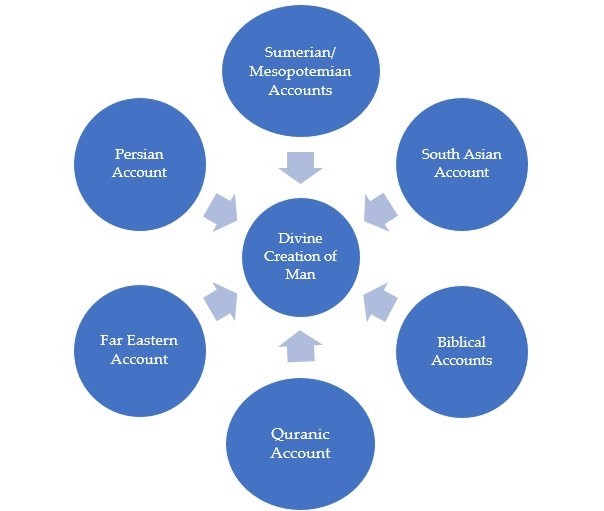
Figure. 1
The consilience of evidence here is compelling: As can be seen in the literature and figure, from the Middle East to the Far East, from the Old World to the New, we see humanity’s collective memory pointing to a divine origin from one man and one woman. The names may be Adam and Eve , Adapa and Titi, Mashye and Mashyane, Ask and Embla, or Svayambhuva Manu and Satarupa, but the core identity is the same. These are different cultural names for the same original ancestors. In Islamic terms, all these traditions recall Adam and his wife – the first humans – albeit in fragmented and folkloric form. Such broad agreement is unlikely to be pure invention. It’s as if the story of our first parents was imprinted on human consciousness from the earliest days of our species, to be carried and retold by disparate peoples as they spread across the world. Just as linguists can reconstruct a proto-language by comparing diverse tongues, the shared motifs in these myths allow us to reconstruct the proto-story of human origin – one that aligns closely with the account given in divine revelation.
Prophethood of Adam
Islam presents Adam not merely as the first man but as the first receiver of revelation, hence the first prophet. 50 His reception of ‘words’ from God constitutes a direct instance of divine communication, the essential mark of prophethood. Immediately after, Allah promises to send continuous guidance to mankind, 51 confirming that revelation began with Adam and would persist through his progeny. The verse ‘Indeed, Allah chose Adam , Noah , the family of Abraham , and the family of ‘Imran over all the worlds’ 52 further situates Adam within the genealogical line of divine messengers. The hadith further strengthens this identification. Affirmation of his prophethood is recorded in Musnad Ahmed, 53 Mustadrak 54 and other major books of Ahadith. Another report states that Allah revealed to Adam 10 ṣuḥuf (scrolls), affirming his status as a recipient of divine scripture. 55 These narrations, consistent with Quranic indicators, demonstrate that Adam’s mission encompassed both the recognition of God’s unity and the teaching of moral and practical knowledge to his descendants. Hence, Islamic tradition portrays him as Abul Bashar, the father of humanity, and simultaneously as the first teacher and prophet, inaugurating the continuous chain of divine messengers culminating in the seal of prophethood, Prophet Muḥammad  .
.
Scientific and Anthropological Account of Adam and Eve
Many contemporary scholars of science and philosophy are of the opinion that the story of Adam and Eve do not provide the historical narrative about the origin of humans, as it did not occur in reality. Rather, the account is a figurative, allegorical, or metaphorical piece of literature. 56 The scientific argument which they put forward is that it is impossible for two people to give rise to all the genetic diversity we see in the human population today. 57
This argument was refuted by another research which used logic and numerical simulation to show that there were several designed diversity mechanisms that could reconcile a literal Adam and Eve with the allele frequency distribution which can now be seen in the human population. Their research identified 3 genetic mechanisms, namely: Designed diversity within Adam and Eve’s four sets of chromosomes followed by accelerated genetic drift associated with multiple population constrictions, the above mechanism, combined with more powerful demographic forces such as selective sweeps, lineage extinctions, and differential subpopulation expansions, and designed diversity within Adam and Eve’s originally created gametogonia. Together, these various genetic mechanisms seem to falsify the claim that there was ‘no way’ that Adam and Eve could give rise to the diversity in humans which we see today. 58
Furthermore, the claim that the details mentioned in the scriptures regarding the creation of the universe and the creation of man is merely an allegory piece is false, because the text of the scripture shows that it is not poetic or metaphorical in any sense, rather, it is a historical narrative. Thus, without furnishing proper evidence, it is unwise to call these details as allegory or merely a piece of literature. 59 The only reason the torch bearers of science and philosophy are trying to prove that Adam and Eve were allegory figures is that believing in this narrative destroys the narrative of the evolutionists, on which the scientists and other scholars have been spent countless resources but have only been able to provide some hypotheses-based assumptions with missing links.
Anthropologically, it has been admitted that the story Adam and Eve contains a set of empirically verifiable and universal claims about human nature. 60 This also consolidates the view that Adam and Eve were not allegorical figures, rather they existed, and their story is a proper historical narrative regarding the origin of mankind.
Thus, modern science, through fossils, genetics, and comparative anatomy, reconstructs humanity’s origins by inference rather than direct observation. Secondly, the theory of evolution, though widely accepted, remains an interpretive model built upon fragmentary evidence—fossil remains, genetic sequences, and morphological parallels—arranged to form a plausible picture of descent with modification. Like all historical sciences, it relies on indirect reasoning, extrapolating the unseen from the seen, and while valuable, it can explain how processes occur but not why they began or for what purpose. Yet, if empirical science accepts truth inferred from converging but incomplete signs, intellectual consistency demands that it also respect other forms of inference—those drawn from the universal historical memory and cross-cultural testimony preserved across ancient civilizations from Sumer to the Americas, where remarkably similar accounts of a first man and woman fashioned by God recur. Such global convergence cannot be dismissed as coincidence or mere archetypal projection; rather, it represents humanity’s collective memory of an original revelation. In Islamic theology, this universality is seen not as mythic diffusion but as the survival of a divine truth: that mankind descends from Adam and Eve , whose creation formed part of humanity’s earliest consciousness. Though later generations dispersed and obscured revelation beneath layers of myth, the essential truth persisted—like a refracted but enduring light. Thus, what comparative mythology records as many ‘Adam and Eve’ stories may, in fact, echo one real event: the divine creation of the first human beings. Moreover, recent research employing logical modeling and genetic simulation has demonstrated that a literal Adam and Eve could indeed give rise to modern human diversity through designed mechanisms such as chromosomal diversity, accelerated genetic drift, selective sweeps, and created gametogonia, thereby falsifying claims of biological impossibility. From this view, science basically explores the processes within creation, and revelation discloses the purpose behind it. Where empirical inquiry ends, revelation supplies the dimension of intentionality—the ‘why’ that no fossil can answer. Adam , in this light, was not merely the first biological human but the first conscious worshipper and prophet, endowed with knowledge, morality, and divine guidance. His creation marked not the culmination of an impersonal process but the dawn of a moral order; humanity’s first act was not survival, but recognition—to know and submit to its Creator. Thus, while science traces the body of man, revelation unveils the soul of his story, and yield the most complete understanding of human origins: that mankind began with purpose, intelligence, and worship, for the first man was Adam , and the first religion was Islam—the submission of creation to its Creator.
- 1 Bernard Wood & Nicholas Lonergan (2008), The Hominin Fossil Record: Taxa, Grades and Clades, Journal of Anatomy, Anatomical Society of Great Britain and Ireland, London, U.K., Vol. 212, Issue: 4, Pg. 360.
- 2 Jean-Jacques Hublin & Et al. (2017), New Fossils from Jebel Irhoud, Morocco and the Pan-African Origin of Homo sapiens, Nature, Macmillan Publishers Limited, Hampshire, U.K., Vol. 546, Pg. 289.
- 3 As per scientific literature, Australopithecus were early human-like creatures that lived in Africa between about 4.2 and 1.9 million years ago. They could walk upright like humans but still had ape-like faces and small brains. Scientists consider them an important link between apes and modern humans, showing the early stages of human evolution.
- 4 For scientists, homo erectus was an early human species that lived between about 1.9 million and 110, 000 years ago in Africa, Asia, and Europe. They were the first humans to walk fully upright, use fire, and make complex stone tools. With a larger brain and body than earlier hominins, Homo erectus marked a major step toward modern humans.
- 5 Holly M. Dunsworth (2010), Origin of the Genus Homo, Evo Edu Outreach, Springer Nature, New York, USA, Vol. 3, Pg. 353-354.
- 6 Feng-Chi Chen & Wen-Hsiung Li (2001), Genomic Divergences between Humans and Other Hominoids and the Effective Population Size of the Common Ancestor of Humans and Chimpanzees, The American Journal for Human Genetics, Massachusetts, USA, Vol. 68, Issue: 2, Pg. 444-445.
- 7 According to modern research, Neanderthals were an extinct species of early humans (Homo Neanderthalensis) who lived in Europe and parts of western Asia between about 400, 000 and 40, 000 years ago. They were strong and intelligent, adapted to cold Ice Age climates, and capable of using tools, controlling fire, and burying their dead. According to scientific sources, Neanderthals shared a common ancestor with modern humans and even interbred with them, leaving traces of their DNA in people today.
- 8 Bernard Wood & Sarah Elton (2008), Symposium on ‘Human evolution: Ancestors and Relatives’, Journal of Anatomy, Anatomical Society of Great Britain and Ireland, London, U.K., Vol. 212, Issue: 4, Pg. 335-336.
- 9 Bernard Wood (2010), Reconstructing Human Evolution: Achievements, Challenges, and Opportunities, Proceedings of the National Academy of Sciences, Washington D. C., USA, Vol. 107, Suppl.: 2, Pg. 8902-8903.
- 10 Jacob W. Ijdo & Et al. (1991), Origin of Human Chromosome 2: An Ancestral Telomere-Telomere Fusion, Proceedings of the National Academy of Sciences, Washington D. C., USA, Vol. 88, Issue: 20, Pg. 9051.
- 11 T. Ryan Gregory (2008), Evolution as Fact, Theory, and Path, Evolution: Education and Outreach, Springer Science + Business Media, Berlin, Germany, Vol. 1, Issue: 1, Pg. 51.
- 12 Francisco J. Ayala (2009), Darwin and the Scientific Method, Proceedings of the National Academy of Sciences, Washington D. C., USA, Vol. 106, Suppl.: 1, Pg. 10035-10037.
- 13 Amanda Guillan (2014), Epistemological Limits to Scientific Prediction: The Problem of Uncertainty, Open Journal of Philosophy, Scientific Research Publishing, Wuhan, China, Vol. 4, Issue: 4, Pg. 510.
- 14 Karl R. Popper (2005), The Logic of Scientific Discovery, Routledge, London, U.K., Pg. 16-17.
- 15 Kostas Kampourakis & Tobias Uller (2020), Philosophy of Science for Biologists, Cambridge University Press, Cambridge, U.K., Pg. 193-194.
- 16 Karl R. Popper (1994), Objective Knowledge: An Evolutionary Approach, Oxford University Press, Oxford, U.K, Pg. 69.
- 17 Zachary B. Hancock, Emma S. Lehmberg & Gideon S. Bradburd (2021), Neo-Darwinism still Haunts Evolutionary Theory: A Modern Perspective on Charlesworth, Lande, and Slatkin (1982), Evolution: International Journal of Organic Evolution, Oxford University Press, Oxford, U.K., Vol.75, Issue: 6, Pg. 1244.
- 18 Michael Denton (1986), Evolution: A Theory in Crisis, Adler & Adler, Maryland, USA, Pg. 172.
- 19 Stephane Guindon (2020), Rates and Rocks: Strengths and Weaknesses of Molecular Dating Methods, Frontiers in Genetics, Frontiers Media SA, Lausanne, Switzerland, Vol. 11, Article: 526, Pg. 10.
- 20 Jean-Jacques Hublin & Et al. (2017), New fossils from Jebel Irhoud: Morocco and the Pan-African Origin of Homo Sapiens, Nature, Macmillan Publishers Limited, Hampshire, U.K., Vol. 546, Pg. 289-291.
- 21 Antonio Lazcano & Juli Pereto (2010), Should the Teaching of Biological Evolution Include the Origin of Life?, Evolution: Education and Outreach, Springer Science + Business Media, Berlin, Germany, Vol. 3, Issue: 4, Pg. 662-663.
- 22 Juli Pereto & Jesus Catala (2012), Darwinism and the Origin of Life, Evolution: Education and Outreach, Springer Science + Business Media, Berlin, Germany, Vol. 5, Issue: 3, Pg. 340.
- 23 Gregory W. Dawes & Tiddy Smith (2017), The Naturalism of the Sciences, Studies in History and Philosophy of Science, Elsevier, Amsterdam, Netherlands, Pg. 1.
- 24 Alvin Platinga (2011), Where the Conflict Really Lies: Science, Religion and Naturalism, Oxford University Press, Oxford, U.K., Pg. 240-242.
- 25 Thomas Nagel (2012), Mind and Cosmos: Why the Materialist Neo-Darwinian Conception of Nature is Almost Certainly False, Oxford University Press, Oxford, U.K., Pg. 44-45.
- 26 Carol E. Cleland (2001), Historical Science, Experimental Science, and The Scientific Method, Geology, The Geological Society of America, Colorado, USA, Vol. 29, Issue: 11, Pg. 987.
- 27 R. G. Collingwood (1993), The Idea of History, Oxford University Press, Oxford, U.K., Pg. 249-253.
- 28 Roger Wagner & Andrew Briggs (2016), The Penultimate Curiosity: How Science Swims in the Slipstream of Ultimate Questions, Oxford University Press, Oxford, U.K., Pg. 351-353.
- 29 Niels-Erik Andreasen (1981), Adam and Adapa: Two Anthropological Characters, Andrews University Seminary Studies, Andrews University Press, Michigan, USA, Vol. 19, Issue: 3, Pg. 181.
- 30 Dr. Khalid A. Malik Al-Noori (2015), The Myth of Dilmun: Features of Sumerian Mythological Literature, Journal of Human Sciences, University of Hail, Saudi Arabia, Vol. 26, Issue: 1, Pg. 18-19.
- 31 George Smith & A. H. Sayce (2007), The Chaldean Account of Genesis, Wipf & Stock Publishers, Oregon, USA, Pg. 88-89.
- 32 Edward William West (1897), The Bundahishn (Creation) or Knowledge from The Zand, Oxford University Press, Oxford, U.K., Pg. 18-19.
- 33 Srimad Bhagvatam, Canto 3, 13: 6-12
- 34 Anne Birrell (1999), Chinese Mythology: An Introduction, The John Hopkins University Press, Maryland, USA, Pg. 34.
- 35 Roland B. Dixon (1916), The Mythology of All Races: Oceanic, Marshal Jones Company, Boston, USA, Vol. 9, Pg. 167-169.
- 36 Canon Callaway (1870), Izinyanga Zokubula or Divination, As Existing Among the Amazulu, In their Own Words, Trubner & Co., London, U.K., Pg. 42.
- 37 The Bible, Genesis 2: 7
- 38 The Bible, Genesis 2: 21-22
- 39 The Bible, Genesis 3: 1-24
- 40 Holy Quran, Al-Baqarah (The Cow) 2: 30
- 41 Holy Quran, Al-Hijr (The Rock) 15: 26-29
- 42 Holy Quran, Al-Baqarah (The Cow) 2: 31
- 43 Holy Quran, Al-Baqarah (The Cow) 2: 34
- 44 Holy Quran, Al-A’raaf (The Heights) 7: 189
- 45 Abu Al-Fadl Ahmed ibn Ali ibn Hajar Al-Asqalani (1379 A.H.), Fath Al-Bari Sharah Sahih Al-Bukhari, Dar Al-Ma’rifa, Beirut, Lebanon Vol. 6, Pg. 368.
- 46 Holy Quran, Al-Baqarah (The Cow) 2: 35
- 47 Holy Quran, Al-Baqarah (The Cow) 2: 36
- 48 Holy Quran, Al-A’raaf (The Heights) 7: 23
- 49 Holy Quran, Al-Baqarah (The Cow) 2: 37-38
- 50 Abu Abdullah Ahmed ibn Muhammad ibn Hanbal (2001), Musnad Al-Imam Ahmed ibn Hanbal, Hadith: 22288, Muassasah Al-Risala, Beirut, Lebanon, Vol. 36, Pg
- 51 Holy Quran, Al-Baqarah (The Cow) 2: 38
- 52 Holy Quran, Aal-e-Imran (The Family of Imran) 3: 33
- 53 Abu Abdullah Ahmed ibn Muhammad ibn Hanbal (2001), Musnad Al-Imam Ahmed ibn Hanbal, Hadith: 22288, Muassasah Al-Risala, Beirut, Lebanon, Vol. 36, Pg. 619.
- 54 Al-Hakim Muhammad ibn Abdullah Al-Neshapuri (1990), Al-Mustadrak ‘Ala Al-Sahihain, Hadith: 3039, Dar Al-Kutub Al-Ilmiyah, Beirut, Lebanon, Vol. 2, Pg. 288.
- 55 Ahmed ibn Muhammad ibn Ibrahim Al-Th’alabi (2002), Al-Kashf wal-Bayan ‘An Tafseer Al-Quran, Dar Al-Ihya Al-Turath Al-Arabi, Beirut, Lebanon, Vol. 10, Pg. 186.
- 56 J. P. Moreland & Et al. (Ed.) (2017), Theistic Evolution: A Scientific, Philosophical and Theological Critique, Crossway, Illinois, USA, Pg. 58.
- 57 Dennis R. Venema (2010), Genesis and the Genome: Genomics Evidence for Human-Ape Common Ancestry and Ancestral Hominid Population Sizes, Perspectives on Science and Christian Faith, Massachusetts, USA, Vol. 62, Issue: 3, Pg. 173-176.
- 58 John C. Stanford & Et al. (2018), Adam and Eve, Designed Diversity, and Allele Frequencies, In Proceedings of the Eighth International Conference on Creationism, Pennsylvania, USA, Vol. 8, Pg. 200-216.
- 59 J. P. Moreland & Et al. (Ed.) (2017), Theistic Evolution: A Scientific, Philosophical and Theological Critique, Crossway, Illinois, USA, Pg. 58.
- 60 Jack Katz (1996), The Social Psychology of Adam and Eve, Theory and Society, Springer, New York, USA, Vol. 25, Issue: 4, Pg. 545-582.
Hamdani, Mufti Shah Rafi Uddin & Khan, Dr. (Mufti) Imran. (2026, February 12). Creation of Man: Scientific Inference and Divine Revelation. Encyclopedia of Muhammad ﷺ.
https://muhammadencyclopedia.com/article/en/creation-of-man-scientific-inference-and-divine-revelation